Google Search

Loading
Showing posts with label Andaman and Nicobar islands. Show all posts

New coral species discovered from Andaman and Nicobar Islands in India

Ctenactis triangularis, new coral species, andaman coral, nicobar corals, indian corals, coral reefs of india, marine biodiversity, beautiful corals
Ctenactis triangularis from Andaman and Nicobar Islands
Image Credit: C Raghunathan

Shedding light to the rich but unexplored marine biodiversity of India, Scientists of the Zoological Survey of India described a new species of coral reef, Ctenactis triangularis from Andaman and Nicobar Islands of India. The new species which belongs to the family of mushroom corals, adds a fourth member to the Ctenactis genus of corals.

“The first specimen of the species was collected from Rutland Island from South Andaman by snorkeling and skin-diving", said the scientists. Later another specimen of the same coral was observed at the North Bay in South Andaman in December 2008. Researchers were able to spot the same species again after two years, in 2010, off the coast of Elephant Beach in Havelock Island.

Tamal Mondal and C. Raghunathan , scientists at the Andaman and Nicobar Regional Centre of Zoological Survey of India situated at Port Blair have reported and described the identity of the new species.

Distinguishing features of Ctenactis triangularis

According to the ZSI scientists, the newly described species has characteristics which make it different from all the three members of the genus previously reported by other studies.
Ctenactis triangularis, new coral species, indian coral, andaman coral, nicobar coral, indian ocean coral,
Ctenactis triangularis
Image Courtesy: JOTT

The discovery which is published in the Journal of Threatened Taxa reveals that three characteristics make the new species different from its closest relatives.

The major feature is the triangular, flat shaped skeleton or corallum which makes it different. According t the study, ‘divisible mouth fossa, spinulose costal spines and cylindrical septal teeth’ also make it distinguished from other members of its genus.

To underscore one of its most visible distinguishing features – its flat triangular skeleton, the scientists have named it as triangularis. “The species has been named after the triangle-shaped arm like coralla, which gives a unique morphological character to distinguish it from other related species”, says the study.

Conservation Status of Ctenactis triangularis

Despite the new discovery, the future of the coral reefs off the coast of Andaman and Nicobar are likely bleaker, points out the study. “Threats, which can be categorized as natural and anthropogenic, to the reef biodiversity, have been encountered for a long time.”, it says.

According to the researchers, the new species belong to Scleractinian corals which are protected under CITES Appendix II which curbs the transnational smuggling of these corals. Moreover, they are also included in the Schedule I of protected organisms of Indian Wildlife Act, 1972. 

Pygmy sized human ancestor in Central Narmada Valley a missing link in evolution chain, reveals new study


During a recent exploration in the Central Narmada Valley, researchers have unearthed skeletal parts of hitherto unknown archaic humans that have inhabited Central Narmada valley in India during late Mid Pleistocene.

Hominin fossil, hominin fossil india, india fossil, narmada valley fossil, hominin in india
Hominin femur fossil  found from Central Narmada Valley
Image Courtesy: Current Science
According to a research communication published in the Current Science Journal, a partial humeral piece (bone which extends from shoulder to elbow), a fragment of the left femur (bone that extends from pelvis to the knee) and other stone artifacts collected from Netankheri, located 3 km away from Hathnora on the banks of Narmada River, shows that Central Narmada Valley had two different archaic human races.

While one was large robust hominins who used to hunt down large mammals with heavy duty weapons, the later developed pygmy sized one which was hitherto unknown to science, used to hunt smaller animals with lightly refined tools. The pygmy sized race could be the real ancestors of all short-bodied populations in South Asia, says the study.

Anatomical differences
Though the humeral piece was 84 mm in length, scientific estimations reveal that the maximum possible length could be 240mm. In that case, it is shorter than that of the known archaic mainland Eastern Indian races. According to the researchers, the humeral piece has more similarities with that of Chaurite Nicobarese populations.

Hominin humerus, Netankheri fossil, hominin fossil, fossil from India, Indian hominin, India fossil, Narmada fossil, Narmada valley popualtions
Hominin humerus from Netankheri
Image Courtesy: Current Science 
Though it is not easy to confirm if the fossil belongs to modern humans or archaic hominins, the mineralization and the artifacts recovered along with the fossil suggest the period could be Upper Palaeolithic.

Similarly, the femoral piece is different from that of modern humans. The newly discovered femur, according to researchers, has scarcely developed medial and lateral lips while they are prominently developed into ridges in modern humans. A comparative analysis, according to the research communication, makes it more similar to femur of the Neanderthal man or late archaic hominins.

Thus the newly unearthed humeral fossil may belong to a connecting link between the short statured archaic humans to the early modern homo sapience during the late Pleistocene, says the study.

Culturally different race
Excavations at Hathnora earlier have revealed the existence of archaic hominin populations on the Narmada banks dating back to mid- Pleistocene age. However, the present findings, when compared with that from Hathnora, reveal that the races were culturally and physically distinct.

Substantiating the findings, the study points out that the faunal fossils and the types of artifacts recovered from the two sites are different, which in turn suggest that the races were culturally different.
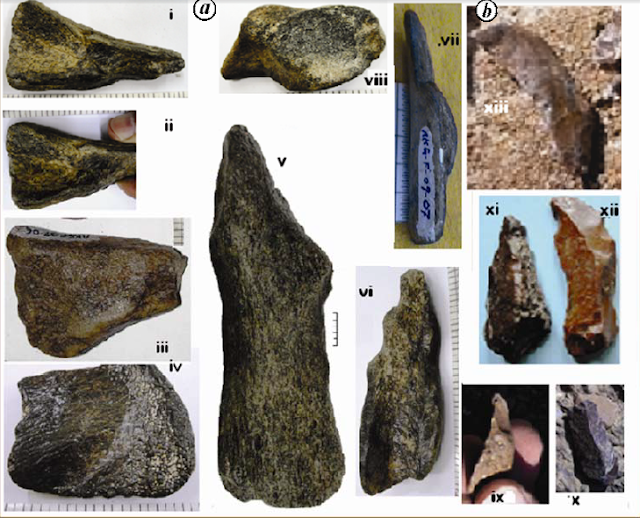
stone tools, stone artifacts, nethankhari stone tools, netankhari artifacts, Pleistocene tools india, mode 3 tools india, mode 3 tools Narmada valley
a. Bone and stone implements associated with human humerus at Netankheri and similar sites. b, Small mode 3 lithic implements excavated at Hathnora clavicle site; such tools were also recovered from Netankheri humerus site.
Image Courtesy: Current Science 
During the excavation at Hathnora, researchers have unearthed a complete mandible or lower jaw of Equus namadicus, a pre-historic era horse like mammal of Narmada valley. Interestingly, a portion of its lower jaw had a pre-historic tool struck in it, pointing out that the animal was contemporary with the man who made these tools.

 Similarly, current excavations at Hathnora partial skull level have yielded a large cache of heavy duty artifacts, many of them associated with large mammalian fossils, suggesting that the Hathnora populations known by the skull were large robust humans and they used to hunt down large mammals also.

However, excavations at Netankheri at the same level yielded very few large mammalian fossils and very few heavy duty artifacts. Researchers were able to unearth some lower jaw remnants of Stegodon insignis ganesa, a pre-historic elephant known for its longer tusks, and very few heavy duty artifacts from Netankheri. While the artifacts at Hathnora contained Picks, chopping tools, cleavers and hand axes, not many similar tools were present at Netankheri. However, the picks recovered from Netankheri at femur level were culturally similar to those of Hathnora skull level and connect the two robust fossil findings.


Central Narmada valley map, fossil map, fossil cites in india
Map of a portion of the Central Narmada valley
Image Courtesy: Current Science 
All these signs, point to the fact that the races were physically and culturally different, to the point that the short-statured race used to hunt only smaller mammals and used more refined tools, than the robust humans in Hatnora. “The fossil and archaeological evidence from Hathnora represent two types of culturally and physically distinct, anatomically archaic hominin populations in the Central Narmada Valley.”, says the paper.

Connecting link to modern human populations on Narmada Valley
These findings throw more light into the evolution of human race in South Asia region. According to the research communication, the humeral piece of fossil belonged to a type of human race which could be a connecting link between short statured archaic human races in Narmada Valley during later Middle Pleistocene to the modern Homo sapiens in the evolutionary chain.

Possibly, the present short bodied South Asian populations could be descendants of this ancestral root. According to the study, the present Munda settlements in Narmada Valley who have phylogenetic similarities with Andaman Pygmies, can be the present continuation of this short statured human race who inhabited the place during late Pleistocene.

According to Dr. A R Sankhyan, the lead author and a retired palaeoanthropologist with Anthropological Survey of India,   the short and stocky people can even be the ancestors of African pygmies. In a media statement, Sankhyan said that the race "could be the ancestors of the short-bodied people of south Asia, those found in the Andaman and Nicobar Islands and African pygmies".
Early human populations in Narmada Valley
Excavations and palaeontological explorations in the Central Narmada Valley have given valuable insights into the prehistoric age with faunal fossils and stone-age artifacts since 1830s. However, the first direct door of knowledge to the archaic human populations here was opened when a partial hominin cranium was found in 1980s. Later, two clavicles and a partial 9th left rib also were recovered from Hathnora.

However, the mismatching nature of the recovered fossils has always suggested the chances of presence of more than one human race in Central Narmada valley.  The present study also points out that the archaic human settlements extend to other places on the banks of Narmada like Netankheri which calls for more studies to unravel the mystery of Central Narmada Valley ancestors. 

MoEF puts down Coast Guard Radar project to save endangered Narcondam Hornbills

Short URL for the Story: http://goo.gl/LtQ9u
In the face of severe protest from the environmentalists and a thumbs down from the standing committee of the National Board for Wild Life (NBWL), Indian Ministry of Environment and Forests (MoEF) has decided to put down the proposal from the Indian Coastguard to divert 0.637 hectare of forest land at the Narcondam Islands in the Andaman sea to install a coastal surveillance RADAR, since the project will adversely affect the life of the endangered Narcondam Hornbill (Aceros narcondami ) which is endemic to the island.

Narcondam Hornbill (Aceros narcondami)
Image Courtesy: Kalyan Varma
According to an official memorandum (F. No. 6-73!2011.\X/L) from the wildlife division of the MoEF, the nests of the birds are located at 200 meters height and the females hornbills usually sheds their flight feathers during egg laying and chick rearing season. This will wipe out the birds in the island even if the proposed area for the project is just 0.7 hectares. Despite its endangered nature, the bird was included in the Schedule I of Wildlife (Protection) Act 1972.

“Even If the area to be used for the project is less than 0.7 hectares, disturbances and damage caused to the habitat due to cutting of road through the area, and because of the regular functioning of RADAR system, is likely to cause irreversible adverse impact on this unique bird, and can even wipe out the whole population”, says the memorandum issued by MoEF.

Strong opposition from NBWL and the greens
According to MoEF, the report submitted by Dr. A. Rahmani, member of NBWL who was entrusted to make an inspection of the site, proposed that the project should not be recommended since it may affect the unique status of the habitat. The other members of the NBWL have also opposed the project when the proposal came for its consideration.

Narcondam Island, Location of Narcondam Island, Narcondam Island map
Location of Narcondam Island
Image Courtesy: Wikimedia Commons
Moreover, several green organizations including BNHS, Conservation India, Kerala Birder have raised alarm calls that the project may affect the remaining population of less than 350 birds in the island. 

"Since this was not a battle fought in Court, it was public sentiment that swayed the decision.", said a BNHS member. Though many of the activists who have fought against the project have not seen the bird directly, they have stood for its life. "Ecologically, this is totally defensible. This is also a win for the idea of keeping an animal alive, even though we don't see it or experience it, in the way we experience other species", said she.


The project was part of installing a chain of static RADAR sensors in the Indian coast to monitor activities in coastal sea. The project was earlier approved by Andaman and Nicobar Island Administration.

 The memorandum has suggested that the coastguard can explore other technologies or areal, satellite, off shore, ship -based or land based surveillance alternatives for the purpose by constituting a committee of experts from various fields. 

Great Nicobar Crake, a new bird discovered from Andaman and Nicobar Islands, India


Scientists at the Zoological Survey of India (ZSI) have discovered a new bird species from the Andaman and Nicobar islands of India. The bird which is now named as Great Nicobar Crake is an unreported member of the Rallina species of birds which are usually called Water Rails or Crakes.

Great Nicobar Crake, new bird from India, Andaman birds, nicobar birds
Photos of Great Nicobar Crake published by the journal
The discovery is published in the latest edition of the journal Birding Asia, according to which, the bird was seen at Govind Nagar tsunami shelter on the east coast of Great Nicobar, 6 km from Campbell Bay during November last year. 

According to scientists, the Water Crakes or the Rallina species of birds are very rare and only 8 species are known so far. IUCN considers these birds as data deficient since their rarity makes it difficult to compile data on these birds. 

Birds of Rallina species are found in Australia and Asia and 3 are seen in India. Among the three, Andaman Crake (Rallina canningi) which is found in Andaman and Nicobar Islands are endemic and is included under the Near Threatened category. As the report of the new bird is now limited only to Andaman and Nicobar islands, it is highly likely that Great Nicobar Crake is also endemic to the islands.

According to the paper titled "An apparently new species of Rallina crake from Great Nicobar Island, India" published by   S. Rajesh Kumar, C. Raghunathan and P.C. Rasmusssen of ZSI, Great Nicobar Crake cannot fly but can run fast. Usually found near water bodies, Great Nicobar Crake is a thick and short bird, with heavy legs and moderately longer toes and short claws. It has moderately long neck and a short tail. 

The presence of pale green bill, heavy orange-red legs and black banded under parts together makes it different from other known members of Water Crakes.

The discovery was made as part of an ongoing ZSI attempt to map the fauna communities of Great Nicobar Biosphere Reserve (GNBR). The project is being carried out under the man and biosphere programme of UNESCO with the sponsorship of Ministry of Environment and Forests.