Ahmedabad city got a unique green feather on its cap
recently when a tree count taken up by the Municipal Corporation has revealed
that the city has the highest number of big and old trees in the state. The
tree count recorded 6.18 lakh trees in the city, among which 22,880 were big trees.
A tree, according to the counting procedure used, is
considered big when the girth size of their trunk is more than 200 cm. Thus 3.7
percent of the total trees in the city turned out to be big trees. This is a
far better amount than that of India’s greenest city Gandingagr.
However, splitting up the total number of big trees in the
city, it was found that 14150 trees marked in the counting had a girth size
between 200 cm to 250 cm, while 6420 trees were sized between 251 to 300 centimeters.
There was 2310 tress with a girth size of over 300 cm, owing to their old age.
The counting also found that the average tree size in Ahmedabad
is bigger than other cities of Gujarat. The tree count has recorded 33619 tress
from all the eight municipal corporations of Gujarat. While in all other municipal
corporations, trees with more than 200 centimeter of girth size constitute only
1.31 percent of the total trees.
The ancient nature and rich heritage of the city when
compared to other cities is said to be the reason for the presence of more old,
big trees in the area.
However, it is yet to see how long the city will hold
the title as the concrete jungle is razing down the remaining natural
vegetation in the satellite areas of the corporation like Bopal, Sanand and
Bhal.
Meanwhile, Bhavnagr, which had the highest number of trees,
recorded lower average tree size. According to officials, it is mainly due to
the large number of Acacia trees in the Victoria Park in the city.
Western Ghats is the catchment area of 3 large
rivers, 13 medium and 17 minor rivers which play a crucial role in the rich
biodiversity of the region and the prosperity of some 105 million people living
in the area. However, these blood lines of the region are under threat mainly
from the burgeoning anthropogenic factors in the name of development and flawed
policies.
Abundance of Globally Threatened fish species in the Western Ghats Rivers
According to an in-depth study report
submitted to the Western Ghats Ecology Expert Panel about major threats to the
riverine ecosystem in the region, dams, mining, tourism, pollution, flawed
agriculture practices and deforestation of the riparian cover (forest patches
along the river banks) are causing visible degradation to the riverine
ecosystems in this World Heritage site. However, K. A. Subramanian who made the
study also includes the presence of alien species in the riverine ecosystems in
the region as another threat.
Alien species, despite their name, do not
come from another planet, but are introduced from non-native ecosystems often
for agricultural purposes, as ornamental organisms or even as biological
controllers. IUCN has identified introduction of invasive as one of the
possible reason for the population decline of native organisms.
Invasive Plant Species in Western Ghats Rivers
Many of the aquatic invasive species in
streams and water bodies in the Western Ghats like Salvinia molesta, Pistia
stratiotes, Eichhornia crassipes, Hydrilla and Ipomea
fistulosa were first introduced as
ornamental plants in aquariums. They later found their ways to the water
bodies, now spreading to almost all rivers in the Western Ghats.
The changes
in the flow pattern and excessive pollution have also helped in the spread of
these weeds, especially in catchments which are reeling under the pressure of
populated areas. By spreading over the water, they clog the flow of the stream
and increase the rate of sedimentation. They cover the water surface, often
without allowing the sunlight to pass through, eventually wiping away the
submerged species of plants by blocking their chances of photosynthesis.
Mikania
macarantha – a Green Threat to the Riparian Biodiversity
Mikania macarantha, is a similar weed which raises
serious threat to other plant species in the streams and riparian ecosystem of
the rivers in the Western Ghats. This plant forms a thick layer over the stream
and the associated riparian forest blocking the sunlight.
Mikania macarantha, an invasive plant in WG rivers
It is
often observed that the invasion of the Mikania macarantha is closely
connected to the presence of degraded riparian forest patches in the course of
the stream. For instance, in many places like Agasthyarmalai and Anamali
region, the weed has been observed as first colonizing streams using degraded
shores in estates and forestry plantations, gradually invading into the healthy
riparian cover in the adjacent forest areas in the upstream gradually degrading
them over a period f time.
Exotic fishes: friend- turned foes?
Exotic
fishes are another destructive species which is raising serious threat to
native organisms in the Western Ghats Rivers. Introduced for aquarium trade, fish farming and as biological controllers, they have invaded the rivers
spreading all over the river network in the area.
Gambusia affinis was widely used as a biological
agent to check the growth of mosquitos. However, their introduction to water
bodies in the region paved their way to reaching Western Ghats wide river
ecosystems. The species have now reportedly colonized many hill streams,
especially in parts of Maharashtra. Though they don’t eat up each and every
native species like some other invasive species do, they raise fierce
competition for resources with native species, often wiping them away locally.
Clarias gariepinus
Clarias gariepinus, the notorious African catfish pet
named African Mushi among fish farmers in Kerala and neighboring states, has
made a bad example of bringing in foreign species for increased production.
According
to an IUCN report on threats on fish diversity in Western Ghats Rivers, Cyprinus
carpio, Oncorhyncus mykiss, Pangasianodon hypophthalmus, Oreochromis
niloticus, O. mossambicus, Osphronemus goramy, Pterygoplichthys
multiradiatus, Piaractus brachypomus, Trichopodus trichopterus, Xiphophorus
maculatus, Poecilia reticulata and Gambusia affinis are listed as
major invasive threats.
Among
these, C. carpio, O. mykiss, G. affinis and O. mossambicus
are listed among the top hundred worst invasice alien species database.
According to IUCN, these dangerous species are more present in the Southernregion of the Western Ghats where the endemism is highest compared to other
areas.
Absence of a national policy for managing
invasive species
According
to the report submitted to the Convention on Protection of Wetlands, Government
of India admits that presence of invasive species has been raising serious
threat to the conserved areas in the country. The document also admits that
there is no management policy or guidelines issued in this direction. But the
government should take immediate actions to make a management policy to check
more invasive species reaching to the pristine ecosystems and degrading them
gradually.
If you think the wonder world of unknown fishes exists only
in the dark trenches of the deep sea, you may be wrong. There are umpteen
fishes and other aquatic creatures which live below the surface of the earth in
groundwater tables often moving through the small cervices of the stones under earth’s
surface.
Like their counter parts in the deep sea, these shy fishes
rarely come out to light, so our knowledge is very much restricted about this
hidden aquatic biodiversity. A recent study sheds some light into these lesser
known subterranean fishes in India.
Horaglanis and Kryptoglanis -
the Enigmatic fish genus of Western Ghats
Horaglanis Krishnai, The Indian blind catfish
The members of the Horaglanis genus appear to have a
prominent mouth at the anterior terminus of the head and transparent skins
which reveals the blood vessels. One of the most noticeable feature is the
pectoral fin changing into a vestigial bud and the terminal positioning of the
anterior nostrils.
Interestingly, the fishes which were observed in laboratory
conditions were found to be able to raise their heads up and down with the help
of hinges at the Pharyngeal region( photo (a)). This is no mean feat since such an ability is
absent in known fish species.
Two species of Horaglanis
have been reported from India- H.
Krishnai and H alikunhi, both
from Kerala. H. Krishnai is distinct with its 23 fin-rays in the dorsal fin and
the 16 fin-rays in the anal fin. Another species which is considered as H.
inquirenda or species which is yet to identified, is also known and was reported from Kerala recently. This organism
has the 20 fin-rays on its dorsal fin and the 15 fin-rays in the anal fin as
their distinguishing marks visibly.
Kryptoglanis – a new genus to the world of subsurface fishes
A new study has added Kryptoglanis,
an unreported genus among catfishes to the acquatic fauna of India recently.
Known as Middu in regional Malayalam, the first identified member of the genus
is K. Shajii, spotted in Kerala.
Kryptoglanis Shajii
Members of Kryptoglanis
genus can be identified with the absence of dorsal fin and the presence of
barbels including the barbell pair on their nose. They have smaller subcutaneous
eyes. Other facial features include superior mouth and a projecting lower jaw.
They are reported to have fan like pectoral fins and a long based anal fin
which is confluent with caudal fin. The caudal fin of the fishes in these
species has less than eight fin-rays.
The second species identified from this genus is yet to be
christened officially.
Common features of
aquatic creatures in subsurface ecosystems
All of these fishes have certain common characters including
the absence of eyes and body pigmentation and can be found only in wells that
are connected with underground water channels.
They lack of hard structures like spines or fin is a unique
characteristic of these fishes that helps their movements through narrow rock
cuts. Moreover, they show photophobia or fear for light - and like to stay in
darker places. Since their skin is transparent, cat fishes of Horaglanis and
Kryptoglanis genus have red colour. However the former changes their colour
within hours of continuous exposure to bright sunlight.
Monopterus digressus
An earthworm like fish found from the similar ecosystem
which belongs to Monopterus digressus is a typical
example for the adapted physical characteristics for living inside congested
stone cracks. No eyes, no fin elements, but just a membranous caudal fin tip.
Body of Monopterus digressus is sub-cylindrical with no scales.
Experts suggest that such catfishes occur more in springs
along the segmented valleys and wetlands in laterite foot hills distributed
along the western periphery of Western Ghats. Based on their field experience,
experts point out that artificial wells located on laterite hill slopes close
to a wetland are places where there is a high chance of finding these enigmatic
creatures. The lateritic geography under the earth surface here helps these
creatures to move through narrow cavities in laterite stones.
Possible sub-surface
ecosystem in Western Ghats?
New reports have spotted Horaglanis
species even from 90 km away from the place where it was first spotted,
indicating the presence of the fish along a larger area. Similarly, the new
study also brings in the second report of M
digressus, this time 115 km away from the first locality.
Though it is high time to jump into conclusions, the
indications are enough reasons to believe that a sub surface ecosystem exist in
the Western Ghats which spreads through a larger area and is almost impossible
to explore due to its subterranean nature.
Now watch a pair of Monopterus digressus in action after the break.
What Makes Kryptoglanis different from other similar fishes?
(Photo Courtesy: Current Science Journal, Video Courtesy: Zoological Survey of India)
At last Western Ghats makes it into the list of Word Heritage
sites. The 21 nation panel of World Heritage committee has included Western
Ghats which is already known as one of the eight hottest biodiversity hotspots
in the world to the list of world heritage sites based on the recommendations
of the International Union for Conservation of Nature (IUCN).
The 160000 km2 area older than the Himalayas
houses many rare plants and animals including endangered and endemic mammals
like Lion-Tailed Macaque. It also turns out to be the remaining patches of already
endangered Asian elephant and Tiger and at
least 325 globally threatened species of organisms. The mountain chain of the
Western Ghats is a decisive factor in the Indian Monsoons also, making it one
of the best examples of the monsoon system in the planet.
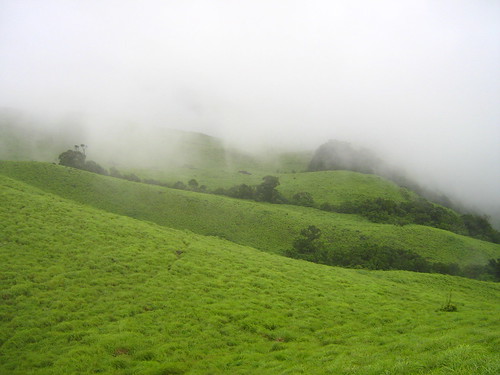
Pythal Mala which is part of Western Ghats in Kannur District of Kerala.
it is listed as an Ecologically Sensitive Area by the panel,
but tourism is eating up this place. Photo Courtesy
Moreover, new explorations have kept on unraveling hitherto
unknown plants and animals from this area showing that its biodiversity potentialbeyond out present understanding.
However, despite the importance and winning the title,
Western Ghats is still not on the priority list of the governments in India. According
to IUCN, the title is an obvious credit to Western Ghats with its spectacular natural
values but the delay was brought by government failure to do the necessary work
to meet the standards of the nomination set by the convention.
This issue can be easily understood from government
approach to the recent Western Ghats Ecology Experts Panel report submitted by
its chairman Dr. Madhav Gadgil. The committee itself was constituted as part of
meeting the requirements of the nominations for World Heritage site tagging
nomination, but when the report was completed the state found that it is full
of bitter truths which kept it from putting it in public domain.
It took months of legal battle to make the report to
come to the public domain and it is presently taking public comments before finalizing.
But the initial response from the politicians and corporate
powers has been torpedoing the attempts to implement the suggestion of the report
since that would curtail the mining activities which are eating away the rich biodiversity
of the area.
The vested interests were very visible in states like Maharashtra
and Goa were the Ghats are severely threatened by the mining mafia. The committee
found no support from state forest departments to get documents and facts about
the biodiversity there.
Many states have already showed their reluctance and
opposition against the report which was reflected in the central stand on the report
later. Let us wait and see if the World Heritage Tag actually help save Western
Ghats and its biodiversity.
The endemic aquatic fauna of southern Western Ghats has got one more member recently, when researchers have identified a new barb belonging to the Puntius family of fishes from the streams in Kerala and Tamil Nadu. Christened as Puntius nigripinnis Sp., this new fish was identified from the streams of TamilNadu and Kerala.
Adult male Puntius nigripinnis sp.
collected from Kalindi river in Wayanad in Kerala, India
(collected by Rahul G. Kumar)
P. nigripinnis now adds to the more than a dozen variants of the widely distributed barb Puntius ticto. The major morphological difference P. nigripinnis has with other members of the P. ticto complex is the absence of barbels along with the presence of the last unbranched dorsal ray serrated.
This dark brown fish has a black band which forms a ring around the caudal fins. Being identified for the first time, it is now known to exist only from Moyar River range in Nilgiris and Kalaindi stream in Wayanad district of Kerala, both streams originating from the southern Western Ghats.
Location of the body spots are one major feature which makes the newly identified fish different from the similar looking close relatives. The humeral spot on this fish is on the 3rd and 4th scale of the lateral line while it is on the 4th and 5th scale below the lateral line for its close relatives like P. punctatus and P. muvattupuzhaensis.
Puntius nigripinnis sp.
Again the black ring is a distinguisher for P. nigripinnis. The large spot which is located on the 18th and 19th scales on the caudal peduncle which forms a band is not prominent in other members of the P. ticto complex. They exist as different spots in P. ticto, P. stoliczkanus, P. manipurensis, and P. pookodensis, making them visually different from P. nigripinnins.
According to a research paper published in the Journal OF Threatened Taxa, researchers and naturalists from Zoological Survey of India and Manonmaniam Sundaranar University has named the fish based on these properties, by coupling the Latin words ‘niger’ which means black and ‘pina’ which means fin. J D Marcus Knight, K Rema Devi, T J Indra and M Arunachalam conducted the study.
Currently known distribution of Puntius nigripinnis sp. nov. A - Kalindi stream in Wyanad (~ 11047’N & 7604’E); B - Kakkan Halla, Moyar River (~11034’N & 76049’E).
The new finding also indicates the richness of unexplored flora of Western Ghats and the importance to conserve it. Though conservation of terrestrial fauna has got popular acceptance, aquatic fauna is still under threat from indiscriminate fishing. Use of pesticides and agro chemicals in the upper stream fields of the Western Ghats Rivers also threaten endemic species like P. nigripinnis.