Google Search

Loading
Showing posts with label butterfly. Show all posts

Butterflies of India – Commander (Moduza procris)


Commander is one of the most beautiful butterflies in India. You may spot this vividly coloured butterfly right from Southern Western Ghats to North Eastern regions. The brilliant reddish brown on its upper side will attract your attention easily.

Usually seen along forest roads, water courses, open places and even close to villages, especially if its larval host plant Mussaenda is available around. If you are planning to take a close look at a Commander, its usual posture of wings pressed flat helps you get a good look. However, if you go close, it will take short flights and keep the distance.

This is part of the Butterflies of India series in Indian Biodiversity Talk's YouTube Channel.


Malabar Wildlife Sanctuary adds five new records to its avian fauna

Oriental Dwarf Kingfisher, Ceyx erithaca, Malabar Wildlife Sanctuary
An Oriental Dwarf Kingfisher (Ceyx erithaca) spotted at Malabar Wildlife Sanctuary during the annual population survey
(Image Credit: Malabar Natural History Society)
  
      The annual population survey of butterflies and birds at Malabar Wildlife Sanctuary in Kerala has added five more species of birds and eight new species of butterflies to the documented biodiversity of the sanctuary. The survey which was jointly carried out by Kerala Forests & Wildlife Department and Malabar Natural History Society during the second week of February was able to record 123 different species of birds at this small sanctuary situated in the Kozhikode district of Kerala.

Chizmi: A Village of Butterflies in Nagaland

yellow coster, nagaland butterflies, chizmi village, butterfly diverity
Yellow Coster is one of the 212 species of butterflies documented at the village of Chizmi


Chizmi may give the impression of any other typical village in North-East India- scenic with lush greenery and its forests. But today this village stands out as an illustrative example of Nagaland’s butterfly diversity. As per the results of a butterfly survey conducted at Chizmi for a period of three years from 2011 to 2014, the village is home to some 212 different species of butterflies. The study is the first of its kind to carry out in Nagaland, after a period of more than 90 years.

Tawny Emperor and Comic Oakblue butterflies spotted in India after 100 years


Comic Blue, Arhopala comica, Tawny Emporer, Chitoria ulupi ulupi, rare butterfly
Comic Oakblue (Arhopala comica)  and Tawny Emporer (Chitoria ulupi ulupi)
Image Credit: 
Tshetsholo Naro/North East Network/JOTT


Butterfly enthusiasts in India have enough reasons to cheer up. Recently published results of a butterfly survey in the far north east state of Nagaland reveal that two rare butterflies have been recorded from here after a long gap of 100 years. As per the results of the survey, Tawny Emperor (Chitoria ulupi ulupi) and Comic Oakblue (Arhopala comica) butterflies were spotted at the village of Chizmi in the Phek District of South Eastern Nagaland. The last known record of these two species from India dates back to 1914. 

Aralam WLS adds Blue Nawab and the Cornelian to its butterfly diversity

Blue Nawab,Polyura schreiber wardii, Indian butterflies, Aralam butterfly, Aralam butterfly survey
Blue Nawab (Polyura schreiber wardii)
 
(Photo Courtesy: Aditya Joshi/Wiki Media Commons under CC BY-SA 2.0)
The latest butterfly survey at Aralam Wildlife Sanctuary, a small protected area situated in the Southern Western Ghats, added two more new winged beauties to its rich insect diversity. The three day survey carried out from January 10 to 12 recorded Blue Nawab and Cronelian butterflies from different parts of the sanctuary for the first time. With the new additions, the total butterfly species found in Aralam WLS increased to 242, according to researchers who participated in the survey.

Though Blue Nawab was recorded from different parts of the state since 2003, this is for the first time that we record the caterpillars of the butterfly from inside Aralam Wildlife sanctuary, said Jafer Palot, Secretary, Malabar Natural History Society which routinely organizes the butterfly survey camp at Aralam each year to monitor and study the altitude migration of Common Albatross and related species of butterflies in the sanctuary.

According to researchers who participated in the survey, migration was abundant this year. During peak hours of migration, the monitoring teams were able to record as much as 1500 butterflying passing a specific spot on the banks of Cheenkani River in one minute period. It has been observed during the earlier butterfly surveys in the sanctuary that hundreds of thousands of butterflies belonging to specific species migrate from upper reaches of Western Ghats to lower reaches though certain fixed routes during this season. However, their point of origin is still unknown just as the destination of their enigmatic journey.

The Cornelian (Deudorix epijarbas)
(Photo Courtesy: Ajit U / Wikimedia Commons under CC BY-SA 2.0)
The new addition again increases the conservation significance of the sanctuary for its rich insect diversity. Even Silent Valley National Park, which is known for its rich and endemic fauna, has only up to 125 species of butterflies recorded so far, says butterfly enthusiasts. Talking to media, V C Balakrishnan, an environmentalist who has been participating in the event for the last several years, said that the new discovery increases the conservation significance of Aralam Wildlife Sanctuary. "This underscores the importance of conserving the place as an important biodiversity spot where butterflies and other winged creatures flock together in lakhs," he said.


According to Balakrishnan, who is an expert in identifying and documenting plants in Western Ghats, the caterpillars of Cornelian butterfly were on Sapindus plant and on Connarus plant. Caterpillars of Blue Nawab were found on a plant which is called as Vallimandaram (Bauhinia phoenicea) in Malayalam.


The butterfly survey camp also reported high mud-puddling on the banks of the rivers Cheekannipuzha and Urutipuzha in the sanctuary. During mud-puddling, butterflies flock to the wet forest floor or on the river banks to suck in nutrients and rare minerals from soil. According to V Madhusoodhanan, Assistant Wildlife Warden of Aralam Wildlife Sanctuary, the three day camp with around 90 participants recorded more than 150 species of butterflies from different parts of the sanctuary this year.

Now, watch the huge butterfly roost observed in Aralam during the migration season of 2013.

Common Mormon bags Butterfly Mumbai Crown


common mormon, Papilio polytes, butterfly Mumbai, BNHS butterfly, BNHS Breakfast with butterflies, beautiful butterflies, butterfly beauty contest
Mating Common Mormon Butterflies at Mundanthurai Tiger Reserve, Tamil Nadu, India
(Image: Indian Biodiversity Talks)
Common Mormon now decorates the coveted title of Butterfly of Mumbai - the financial capital of India. Mumbaikars have selected the most charming common butterfly in their suburbs in a suspense filled competition between a dozen winged beauties. In the race to win the title of the most charming, common butterfly, Common Mormon overtook a couple of winged beauties like Tailed Jay, Common Crow, and Common Emigrant.

Known as Papilio polytes in scientific parlance, this Swallowtail butterfly grabbed the title when biodiversity conservation research organisation Bombay Natural History Society (BNHS) organised a public poll on different common butterfly species, as part of their Breakfast with Butterflies programme, to create awareness among the city folk about butterflies. According to sources, the voting was held at the Facebook page of BNHS also.

During the programme, the 150 participants of the programme voted for butterflies like Common Crow, Tailed Jay, Common Mormon and Common Emigrant. 69 voters elected Common Mormon as the most charming one. Tailed jay, the closest rival in the race, managed to bag 35 votes.

Others beauties failed to make many fans among the voters with Plain Tiger scoring 28 votes and Common Emigrant managing to get 17 votes. Common Crow was the least voted species, with just 9 votes. According to organisers at the BNHS, butterfly species were selected for voting based on their popularity and wide distribution in Mumbai.

“Common Mormon is just like any Mumbaikar”
According to Dr. V.Shubhalaxmi, Deputy Director, BNHS, Common Mormon has a lot of similarity with an average Mumbaikar. “Common Mormon resonates the spirit of Mumbai by being elegant and beautiful yet ‘street smart’ to remain grounded. Like any Mumbaikar, Common Mormon fights the odds of life by adjusting with its environment by adopting strategy of mimicry”, she said.

She sketches out more striking similarities between the newly elected Butterfly Mumbai and the Mumbai life. “As the young love their food with a dash of curry leaf tadka and drops of lemon juice, so does the Common Mormon’s caterpillar”, she said. Next time you see a Common Mormon, remember they are our buddies and let them live and flourish with us, she reminds.


Watch mating Common Mormon butterflies. The female is mimicking Crimson Rose

The swallowtail butterfly belonging to the Papilionidae, is widely distributed in India and other parts of Asia. The female Common Mormon butterflies show an interesting example of mimicry in the insect world. Some female Common Mormon butterflies mimic Common Rose while some other mimic Crimson Rose, both distasteful to birds due to the poisonous food plants they eat during their larval stages. Common Mormon lays its eggs in Curry leaf plant or lemon plant. 
claimtoken-527c8a6e69909

The Story of Finding Callerebia dibangensis: An Interview with Purnendu Roy


Callerebia dibangensis (Image Courtesy: Purnendu Roy)
A pleasant surprise hit us recently from the lush greenery of Dibang Valley in Arunchal Pradesh, when Purnendu Roy, a naturalist, discovered a new butterfly species Callerebia dibangensis from Mithun Valley, approximately 5 kilometres from Aini. The surprise was double-fold. First- The butterfly was present in the region at least for the last 26 years,(as we know now) but was overlooked so far. Second- Roy was not a full-time scientist, but just a naturalist, with a particular interest in the eastern Himalaya. 

So when we contacted Roy to know more about the story behind this discovery, he responded to us in detail. Here we share our email interview with Purnendu Roy for our readers.

Q. What was the most difficult part in deciding the identity of the new species?

A. The only field guide I had in 1987 was a reprint of Wynter-Blyth "Butterflies of the Indian Region".  Though pretty comprehensive it poorly covered the northeast, the plates were of an extremely poor quality and some of the keys were not sufficient to identify all the species you would come across in the NE.

At the end of my trip in 1987 I had several species of interest which I could not identify. I tried to identify them by checking the literature available at the Zoological library. I had some success in some of the species, but the literature on Callerebia was not very illuminating and very few species were actually illustrated so I reached a dead end trying to identify that specimen.

In April 2012 I assisted Sanjay Sondhi of the Titli Trust(a non-profit nature conservation organisation based in Dehradun) with a biodiversity survey of Pakke, Sessa and Eaglenest in Arunachal Pradesh. At Eaglenest we saw Gonepteryx amintha thibetana which I had previously collected from the Dibang valley in 1987, but never reported. In the preparation of that paper, I took the opportunity to look again at some of the specimens I was not able to identify in 1987.

It was through the assistance of Dr David Lees at the British Natural History Museum, London that some of the species were finally determined, but there was nothing quite like this Callerebia in the NHM collection and it was suggested that I should describe it as a new species.

Not having access to comparison materials is the biggest obstacle for identification and is one of the main reasons why I am strong supporter of open access resources. The more materials we have on open access the easier it will be for naturalists to document and make discoveries.

Q. It appears to have a long gap between collecting the specimen and publishing the study (almost more than 25 years). Why was it so delayed?

A. As I said earlier, I reached a dead end in trying to identify some of the species. I subsequently concentrated on my work in fair trade. In 2012, my partner insisted that I take a sabbatical from work and go back to my interest in butteflies and this led to me to the work of Sanjay Sondhi.

I was a member of the Bombay Natural History society earlier, but I never really made contact with anyone else interested in butterflies in that society. The internet has made it easier now to connect with people and I think this is encouraging a resurgence in Indian butterfly interest and is also enabling me to keep up my interest. 

Q. In the study, you point out that Upper Dibang valley has certain geographical characteristics which increases the endemic nature of the species found here. Does it increase the conservation significance of the place?

A. I think so. In addition the whole of the Dibang river watershed lies within India. It is relatively intact with unbroken stretches of sub-tropical forests to the permanent snow line of the main Himalayan range. I am not sure if there is any comparable region in India.

Q. Is there any specific threat for the species in particular and the other insect diversity in the area?

A. At the elevation it was collected there are no specific threats. The proposed Dibang dam is however a serious threat to the riverine forests at lower elevations as highlighted by the MoEF forest panel which rejected the clearance.

Q. It is interesting to see that the species was overlooked for such a long period. Is it actually pointing out that there could be more unknown species in the area? Do you think there is need for more systematic surveys in these areas?

A. If in a well studied group such as butterflies a new species has been overlooked then I think it does illustrate that more new species especially in the less studied fauna will be discovered. There is certainly a need for more systematic studies so that a greater range of altitudes and seasons are covered.

Q. After the publication of the study, did you get any correspondence from any other part regarding the report of the species?

A. None as yet. Recently though another one of the species I recorded in the Dibang valley has been photographed and an article on that species will be published at a later date.

As I work very much with communities in fair trade. I would very much like to see community and grass roots involvement in any conservation initiatives. I am hope that I do get some correspondence in this respect.


Discovery of Callerebia dibangensis, is a pleasant surprise. However, what Purnendu did, adds to the pleasant part of it. From age immemorial, the knowledge of the biodiversity was vital for survival of the human. So the earlier communities handed over the knowledge through their folk songs, tales and traditional customs. When we started devouring the nature and entrusted the responsibility of studying nature upon university courses and arm chair scientists who hate field trips, we left out that vital knowledge, which will decide the fate of being human. 

It is again the time when we need people’s participation in indexing and conserving biodiversity at local level. Purnendu’s attempt, even after a long delay, is a good sign in that way. Let’s hope it will inspire the umpteen people biodiversity initiatives budding around the country.

New Butterfly Species Discovered from Upper Dibang Valley in Arunachal Pradesh


Callerebia dibangensis, Callerebia dibangensis upperside, Upper Dibang Valley, butterflies of Arunachal Pradesh, new butterfly species, indian butterflies, north east butterflies
Callerebia dibangensis, was discovered from Upper Dibang Valley in Arunachal Pradesh 
(Image Courtesy: Purnendu Roy)


According to a new research study published in the Journal of Threatened Taxa, a researcher has identified and described a new species of butterfly from Upper Dibang Valley district of the North Eastern state of Arunachal Pradesh in India. The newly identified butterfly has a set of distinctive characteristics which makes it different from its closest relatives, it says. After confirming the identity of the species as a separate one, the researcher has named it after the biodiversity rich Dibang Valley.

Christened as Callerebia dibangensis, the new species joins the league of roughly 11 species and 20 subspecies of closely related butterflies in the Callerebia genus, which are found exclusively in the Himalayan regions of India and China. 

However, the story of establishing theidentity of the new butterfly species Callerebia dibangensis is rather a long one. According to Purnendu Roy, who described C. dibangensis, this Nymphalid butterfly was spotted and collected in 1987, approximately 26 years back, from Mithun Valley in the Upper Dibang valley, Arunachal Pradesh.  But subsequent work on the identification and describing the species was delayed due to personal as well as technical reasons, according to Roy. The specimen is presently deposited at the Natural History Museum, London.

Key features of C. dibangensis
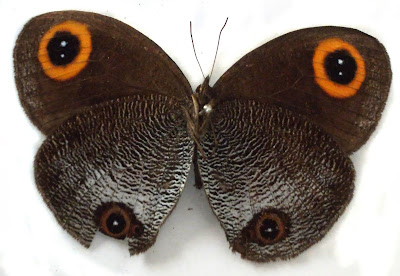
A combination of very distinctive characters like large size; highly rounded wings; striking under hindwing white scales; distinctive under hindwing tornal ocelli (an eye like marking on the posterior corner of the wing); large round orange spot on the anterior corner of the forewing  and a dark brown underground colour distinguishes Callerebia dibangensis from its similar looking relatives in the Callerebia  genus. 
Callerebia dibangensis underside
(Image Courtesy: Purnendu Roy)
The first specimen of the species was collected along the track that leads from Anini to Mipi between the altitudes of 1600–1800 meters, approximately 5–10 km from Anini. According to the study, the winged beauty was spotted at a place with surrounding vegetation of mixed sub-tropical broad-leaf forest.

Unlike the usual practice of baptizing new species with a scientific name and a common name, the author of the study has urged the people of Dibang Valley to give a common name to the new species.

 According to a press note released on the study, the Mishmi weaving of the local people is known to be influenced by butterflies like Northern Jungle Queen. Since the new butterfly species has beautiful white lines on its hind wing, which indeed resembles some patterns of the weaving culture, it may have a local name. 

“It cannot be ruled out that it does not have a local name already. If it does not have a local name, this could be an opportunity for local conservation or community groups to give it a common name to promote the conservation of the Dibang valley forests.”, says the press note.

Overlooked for two decades
The new discovery, however, points out certain realities on our knowledge about the rich biodiversity of our country. The fact that the existence of a new species among butterflies, which are intensively studied by entomologists as well as nature enthusiasts, was over looked for many years is a shocking surprise. According to Roy, the remote nature of Dibang Valley and difficulties in accessing these areas during tough weather can be reasons why very few butterfly surveys have been carried out here. Recently, rare butterfly Empress was rediscovered from the area after a gap of 88 years.

“If in a well-studied group such as butterflies, a new species has been overlooked, then I think it does illustrate that more new species, especially in the less studied fauna will be discovered(from the area). There is certainly a need for more systematic studies so that a greater range of altitudes and seasons are covered”, Roy said in an exclusive email interview with Indian Biodiversity Talks. 

The researcher also thinks that the butterfly can be endemic to the valley due to the specific geographic nature of the place. There is no specific threat to the new species, at present, says Roy. “At the elevation (from which) it was collected, there are no specific threats. The proposed Dibang dam is however a serious threat to the riverine forests at lower elevations as highlighted by the MoEF forest panel which rejected the clearance”, he said.