Sapphire eyed Spreadwing (Lestes praemorsus) is a beautiful damsel fly found in India and other Asian countries. Watch the damsel flies mating on the tip of an ornamental plant. Recorded from Kannur, Kerala

News and updates about Indian Biodiversity Conservation.
Updated research findings and conservation measures about Indian biodiversity.
Showing posts with label dragonflies. Show all posts
Showing posts with label dragonflies. Show all posts
Indian damsel flies - Sapphire eyed Spreadwing (Lestes praemorsus) mating video
Sapphire eyed Spreadwing (Lestes praemorsus) is a beautiful damsel fly found in India and other Asian countries. Watch the damsel flies mating on the tip of an ornamental plant. Recorded from Kannur, Kerala

Dragonflies and Damselflies of Peninsular India - A Field Guide
short url for the story : http://goo.gl/cEVZh
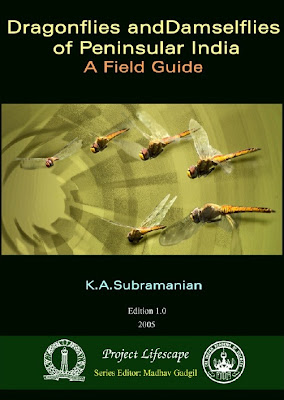 The book prepared by famous scholar K A Subramanian, who has
made extensive studies on odonates and fresh water biodiversity, was published
under the Project Lifescape of IAS in 2005. Just to make it a perfect beginners field guide, it has
pictures, and descriptions which help us identify species in a field trip. Moreover,
to suit it to any beginner, the electronic version of the book is distributed
free also.
Nature is around us, but we need a stepping stone to enter
that world and understand its wonders. That way, dragon flies and damsel flies
are the most suitable keys t explore the wonders of the world. However, they
are numerous and are difficult to understand. This is the reason why Indian
academy of Sciences has published ‘Dragonflies and Damselflies of Peninsular
India - A Field Guide’, as a basic field guide for identifying most common
dragon flies and damsel flies seen in different parts of India.
 The book prepared by famous scholar K A Subramanian, who has
made extensive studies on odonates and fresh water biodiversity, was published
under the Project Lifescape of IAS in 2005. Just to make it a perfect beginners field guide, it has
pictures, and descriptions which help us identify species in a field trip. Moreover,
to suit it to any beginner, the electronic version of the book is distributed
free also.
The book in its electronic version is available in three
parts with a detailed introduction which gives a clear idea about different
body parts of a damsel fly and dragon fly and also about the terms used in the field
guide to describe type specimens of each family. It also keeps detailed illustrations
which help any inexperienced dragon fly watcher to get the basics right.
As Professor Madhav Gadgil points out in the forward to the
book, “If we get to know them (odonates) better, we are apt to become more
concerned with their welfare. That, in turn would mean broader support for our efforts
to conserve, and prudently use, India’s rich heritage of biodiversity”.
We hope the field guide will thus unlock the wonder world of
nature for more people through dragon flies and damsel flies, gradually leading
them to a broader understanding about the need to conserve the rich biodiversity
on mother earth.
Download Dragonflies and Damselflies of Peninsular India - A Field Guide free from IAS's Project Lifescape page here,
Or
Download PDF files of Dragonflies and Damselflies of Peninsular India - A Field Guide from the link below.
Introduction
Dragon Flies
Damsel Flies
Or
Download PDF files of Dragonflies and Damselflies of Peninsular India - A Field Guide from the link below.
Introduction
Dragon Flies
Damsel Flies
Why dragon flies are important to Human beings?
Buddha once said that human has more to study from
butterflies than from text books. Same is the case with dragonflies, as far as
ecologists are concerned. But why? Wonder why do the elite human race with well-developed
brains at his command to survive natural challenges care such a weak creature?
 |
| Dragonfly resting on a leaf |
Best bio-indicators
Recent researches say that dragonflies, just like butterflies, are prominent indicators of ecosystem health. Any change in the ecosystem will first make a visible mark on dragonflies, be it the climate change or a chemical war.
For instance, some districts in the South Indian states of
Karnataka and Kerala report large scale health issues among the people due to
the areal spray of Endosulfan, a pesticide which is banned in many European
countries. The adverse effect of the pesticide was not studied before starting
its use. It grabbed media attention only when a doctor practicing in one of the
villages noticed large number of cancerous abnormalities among his patients,
years later.
But, the sign was visible very early, but nobody had the
eyes to see it.
The area recorded an abnormal fall in the population of
damsel flies and butterflies. They were the first creatures wiped out by the
pesticide reaction. If an ecologist or nature lover detected the change and
raised the alarm, they would have been able to avert many of the deaths (thousands
of them, which still continue) in the area.
Any such changes to the ecosystem first reflect on these
weak creatures. In South Africa, it was found that the species diversity of dragonflies
directly relates to human disturbance and resulting degradation of an
ecosystem. The dragonflies in the undisturbed areas were rare or endemic to
that region while those found at the disturbed riparian patches were common or
general in nature.
Biological Pest Control Agents

Damsel flies also offer important ecological services

Dragonfly larvae are known predators of larvae of mosquitoes and
black flies which are vectors of fatal diseases. The adult dragonflies devour mosquitoes and similar blood sucking flies which carry diseases.
It has made them effective bio control agents against mosquitoes and insect vectors of some diseases. Granite Ghost (Bradinopyga geminate), a container breeding dragonfly is widely
used in Thailand as a biological controller of Aedes mosquito which
spreads dengue fever. Its use in the urban areas was proved effective in preventing
dengue outbreak and spread.
Similarly,
dragonflies help the farmers in pest control too.
Kerala gets a new dragonfly added to its insect fauna
The south Indian state of Kerala has got a
new entrant to its list of insects recently when a group of researchers have found Microgomphus souteri Fraser, a dragonfly which was not spotted from the state in the past. The fly adds to the 138 member strong Odonata fauna of Kerala.
The new fly adds to the 138 member
strong Odonata fauna of Kerala. The insect was spotted from Vlayamchal in the
Aaralam Wildlife Sanctuary in Kannur district which is located in the slopes of
the Brahmagiri ranges in northern Western Ghats.
The fly which belongs to the Microgomphus genus actually
comes under Gomphidae family of dragonflies which are also known as Club-tails for the bulbous last segment of their abdomain. The Microgomphus members of Gomphidae are the smallest in the family with a unique appearance of black and greenish yellow
colours.
 |
| Microgomphus souteri found in Aaralam Wild Life Sanctuary in Kerala (Photo courtesy Dr. Mohammed Jafer Palot ) |
Among other members of the genus Microgomphus, M. souteri differs with Antehumeral stripes on its thorax which are not confluent with mesothoracic collar. Apart from other features, the two large triangular greenish spots on the black labrum also helps distinguishing them. The 4th and 5th abdominal segments of this fly don’t have the mid dorsal oval yellow spots while the 8th and 10th segments have no yellow markings.
However, it is also reported that the specimen
collected from Aaralam Wildlife Sanctury showed minor variations from the specimen in the earlier
record.
Distribution
of Microgomphus souteri
Usually found in the humid parts of the
Western Ghats and North East India from heights of 609.5 MSL and above, other
members of this genus are reported from South Asian countries like Myanmar,
Malaysia, Sumatra, Singapore, Sri Lanka, Cambodia, Laos, Vietnam, Borneo and
Africa.
Though usually arboreal, the males of the
species are found resting on rocks in the streams or vegetation on the
banks of their parent rivers. India has four members of the species M. chelifer, M. torquatus (Selys,
1854) and M. verticalis (Selys, 1873), apart from M. souteri.
The present study is the second recorded spotting
of the species from India, the first being from Sampaje in Coorg district of
the adjacent state of Karnataka some 88 years back.
Subscribe to:
Posts (Atom)