Google Search

Loading
Showing posts with label Horaglanis alikunhi. Show all posts

New enigmatic blind cat fish species named after missile man of India

Short URL of the story:  http://goo.gl/EKpQY

The lesser known subterranean world of blind catfishes in the Western Ghats now has some connection with the missile man of India, as a newly identified species of blind cat fish was named after A P J Abdul Kalam, former India President and well-known aerospace engineer who was instrumental in developing India’s ballistic missiles and launch vehicle technology. Collected from a dugout well of Irinjalakkuda in the South Indian state of Kerala, the new cat fish species has been christened as Horaglanis abdulkalami.

Third blind cat fish known to science 
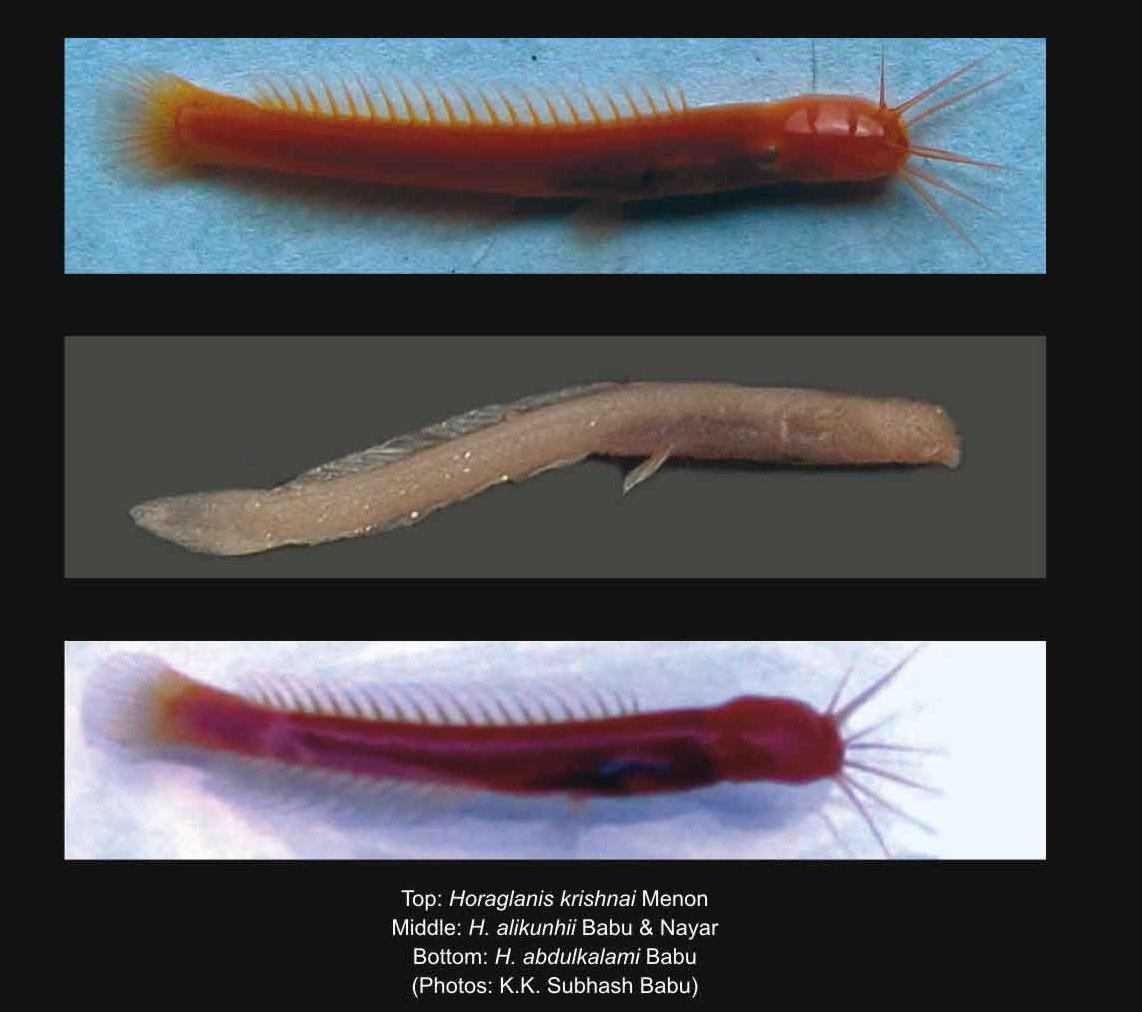
Horaglanis krishnai, Horaglanis alikunhii, Horglanis abdulkalami, blind cat fishes, subterranean fishes
Horaglanis krishnai, Horaglanis alikunhii and Horglanis abdulkalami
According to the research paper published in an Indian journal regarding the discovery, the new species is physiologically different from the two known blind cat fish species - H. Krishnai and H. alikunhii

Gill membrane of the newly found fish is free at the base of the isthmus. They are united only half distance towards the tip of the lower jaw from the base. Moreover, the presence of 13 brancheostegal rays and the 21 unbranched rays on the dorsal fin also makes it different from other known species. In addition, the newly identified fish has a rounded caudal fin with 28 rays with six of them branched.

The new fish is 3.8 cm long and was red blood in colour when first collected. Like similar species, H. abdulkalami is also blind, an adaptation for its dark subterranean habitat, says researchers.

According to Dr. K K Subhash Babu who has collected the fish and described it, the fish still retains respiration through the skin. “With help of Scanning electron microscope (SEM), we can see its body with full of pores, especially head region.  Apart from its gills respiration, they can respire through its skin also. It is very common with all newly hatched fishes which slowly turn to gill respiration. But H. abdulkalmi, seems to retain this capacity”, says he.

Missile Man connection of H. abdulkalami


Illustration, pectoral and pelvic fin of H. abdulkalami, abdulkalami
Illustration showing pectoral and pelvic fin of H. abdulkalami
According to the researcher, he has decided to name the new discovery after Kalam, whom he found inspiring as a researcher. “When I was in Cochin University, I wrote to him about this fish and my intention to give his name to this remarkable fish and he very much appreciated my work”, he said.

Presently an Assistant Professor at the Department of Biology at University of Jimma in Ethiopia, Dr. K K Subhash Babu shares the credit of describing another blind catfish under the same genus – Horglanis alikunhi with another researcher.

The new discovery now adds to our limited knowledge of the unexplored word of subterranean eco system of the Western Ghats.

Subterranean Eco System of Western Ghats – a Mysterious World Still Unexplored


 If you think the wonder world of unknown fishes exists only in the dark trenches of the deep sea, you may be wrong. There are umpteen fishes and other aquatic creatures which live below the surface of the earth in groundwater tables often moving through the small cervices of the stones under earth’s surface.

Like their counter parts in the deep sea, these shy fishes rarely come out to light, so our knowledge is very much restricted about this hidden aquatic biodiversity. A recent study sheds some light into these lesser known subterranean fishes in India.

Horaglanis and Kryptoglanis - the Enigmatic fish genus of Western Ghats

Horaglanis Krishnai, subterranean fishes, western ghat cat fishes,
Horaglanis Krishnai, The Indian blind catfish 
The members of the Horaglanis genus appear to have a prominent mouth at the anterior terminus of the head and transparent skins which reveals the blood vessels. One of the most noticeable feature is the pectoral fin changing into a vestigial bud and the terminal positioning of the anterior nostrils.
Interestingly, the fishes which were observed in laboratory conditions were found to be able to raise their heads up and down with the help of hinges at the Pharyngeal region( photo (a)). This is no mean feat since such an ability is absent in known fish species.

Two species of Horaglanis have been reported from India- H. Krishnai and H alikunhi, both from Kerala. H. Krishnai is distinct with its 23 fin-rays in the dorsal fin and the 16 fin-rays in the anal fin. Another species which is considered as H. inquirenda or species which is yet to identified, is also known and was reported from Kerala recently. This organism has the 20 fin-rays on its dorsal fin and the 15 fin-rays in the anal fin as their distinguishing marks visibly. 

 Kryptoglanis – a new genus to the world of subsurface fishes
 A new study has added Kryptoglanis, an unreported genus among catfishes to the acquatic fauna of India recently. Known as Middu in regional Malayalam, the first identified member of the genus is K. Shajii, spotted in Kerala.

Krypotglanis Shajii, subterranean fishes in India, western ghast cat fishes, cat fishes in Peninsular india
Kryptoglanis Shajii
Members of Kryptoglanis genus can be identified with the absence of dorsal fin and the presence of barbels including the barbell pair on their nose. They have smaller subcutaneous eyes. Other facial features include superior mouth and a projecting lower jaw. They are reported to have fan like pectoral fins and a long based anal fin which is confluent with caudal fin. The caudal fin of the fishes in these species has less than eight fin-rays.

The second species identified from this genus is yet to be christened officially. 
 
Common features of aquatic creatures in subsurface ecosystems

All of these fishes have certain common characters including the absence of eyes and body pigmentation and can be found only in wells that are connected with underground water channels.

They lack of hard structures like spines or fin is a unique characteristic of these fishes that helps their movements through narrow rock cuts. Moreover, they show photophobia or fear for light - and like to stay in darker places. Since their skin is transparent, cat fishes of Horaglanis and Kryptoglanis genus have red colour. However the former changes their colour within hours of continuous exposure to bright sunlight.

Monopterus digressus, spineless fishes, blind fishes, western ghats fishes, subterranena fishes
Monopterus digressus
An earthworm like fish found from the similar ecosystem which belongs to Monopterus digressus is a typical example for the adapted physical characteristics for living inside congested stone cracks. No eyes, no fin elements, but just a membranous caudal fin tip. Body of Monopterus digressus is sub-cylindrical with no scales.

Experts suggest that such catfishes occur more in springs along the segmented valleys and wetlands in laterite foot hills distributed along the western periphery of Western Ghats. Based on their field experience, experts point out that artificial wells located on laterite hill slopes close to a wetland are places where there is a high chance of finding these enigmatic creatures. The lateritic geography under the earth surface here helps these creatures to move through narrow cavities in laterite stones.

Possible sub-surface ecosystem in Western Ghats?

New reports have spotted Horaglanis species even from 90 km away from the place where it was first spotted, indicating the presence of the fish along a larger area. Similarly, the new study also brings in the second report of M digressus, this time 115 km away from the first locality.

Though it is high time to jump into conclusions, the indications are enough reasons to believe that a sub surface ecosystem exist in the Western Ghats which spreads through a larger area and is almost impossible to explore due to its subterranean nature. 

Now watch a pair of Monopterus digressus in action after the break.


What Makes  Kryptoglanis different from other similar fishes?
Krypotglanis shaji, Kryptoglanis species 2, Heteropneustes, Clariidae, Ompok, Siluridae, Ailia, Schilbidae

(Photo Courtesy: Current Science Journal, Video Courtesy: Zoological Survey of India)