Restricted to the Western Ghats of India and parts of
Central Sri Lanka, Hump Nosed Pit Viper loves spending day in the leaf litter
on the forest floor. This snake is a perfect example for camouflage, since spotting it in the leaf litter on the forest floor is a difficult task.

News and updates about Indian Biodiversity Conservation.
Updated research findings and conservation measures about Indian biodiversity.
Showing posts with label : kerala. Show all posts
Showing posts with label : kerala. Show all posts

Happy Environment Day 2015 !

We would like to share a hope with our readers on this Environment Day,
that this mystic tree of life - our planet - sustain for long.
Lets pray that humans may someday turn more sensible about the ways they kill this tree of life, if not, let them perish, before they wipe out the last throbs of life on our mother earth.
May this mystic tree of life sustain long. . .
Happy Environment Day 2015 !
(Image: A moss covered tree from the shola forests of Southern Western Ghats of Kerala in India.)
Rare plant rediscovered after 75 years from Kallar Valley in Western Ghats of Kerala
Researchers at
the Jawaharlal Nehru Tropical Botanic Garden and Research Institute has
discovered an elusive plant - Ophiorrhiza barnesii, which was thought to
be ‘possibly extinct’ since its first discovery, from Kallar Valley in Idukki
district of the Southernmost Indian state of Kerala. According to a journal
article about the discovery published in the latest issue of the Journal of
Threatened Taxa, the plant was last reported 75 years ago, in 1937 by British botanists.
 |
| Ophiorrhiza barnesii, a rare plant rediscovered from Southern Western Ghats |
According to
sources, the researchers accidentally zeroed in on the plant while making a collection
of threatened plants of Southern Western Ghats for ex situ conservation. The
discovery now throws light into the still to be explored floral richness of
Western Ghats, which is one of the eight hottest hot-spots in the world. The plant is one among the 20 members of the Ophiorrhiza
genus found in the state of Kerala.
‘Possibly Extinct’
It was in 1939, that the plant was first
described by a British botanist C E C Fischer based on two collections made by
another British Botanist Prof. Edward Barnes. Both of the two specimens were
collected from Kallar Valley during 1937. However, the plant has remained
elusive since then with no further collectors or researchers reporting the
plant from any other part of the state. According to researchers, subsequent
botanical explorations even considered the chances that the plant may be possibly
extinct by this time.
However, the rediscovery now puts it in the
class of the rarest plants found in the Southern Western Ghats. To confirm the
authenticity of the claim, the researchers reportedly compared the present
specimen collected form Kallar Valley with the specimens in the earlier
collections preserved at Royal botanic Gardens, Kew in London.
The Elusive plant
of Western Ghats
The elusive plant is just like any other
casual plant you may find in the Western Ghats with its perennial erect herb
nature. Usually found as part of the under growth in the evergreen forests of
the Western Ghats at an altitude of 1200 to 1600 meters from the mean sea level,
the plant bears small white flowers. The flowering and fruiting season of the
plant falls in the September to December period.
According to researchers, the plant is also
found along the banks of the streams in the forests. It is found “usually
associated with Sonerila wallichii, Ophiorrhiza roxburghiana, O.
barberi, Elatostemma sp., etc”, says the research article.
However, with the rediscovery, researchers are
raising doubts about the identity of another rare plant of the same genus found
in Western Ghats - Ophiorrhiza falcate. Described by British naturalist Beddome in 1861 from the Anamalais, the plant resembles O. barnesii, in its
description.
 |
| Flowers of Ophiorrhiza barnesii |
However, rigorous searchers in the specimen
collections in the foreign herbariums where the collections from pre-independent
India are kept failed to trace back the original specimen based on which
Beddome described the species.
“Unfortunately, searching the specimens at The
British Museum, Natural History (BM); Royal Botanic Gardens, Kew (K) and The National
Herbarium, The Netherlands (L) also became futile.”, says the researchers.
Researchers seriously doubt that both the
species should be one and the same; however, without detailed surveys at the
Anamalais, it will be too early to speculate in that direction, say the
researchers.
After the discovery, now a specimen of the
plant is preserved at the herbarium at the Jawaharlal Nehru Tropical Botanic
Garden and Research Institute in Palode in Thiruvananthapuram. The researchers have
also added some individuals of the plant to the gene pool that is developed in
the institute as part of ex situ conservation of wild plant varieties.
E.S. Santhosh Kumar, P.E. Roy, and S.M.
Shareef from Jawaharlal Nehru Tropical Botanic Garden and Research Institute,
Palode, Thiruvananthapuram, Kerala have co-authored the study.
Fighting the aliens at Periyar Tiger Reserve
Periyar Tiger
Reserve (PTR) is not just a safe haven for the tigers, but for some aliens too,
in the ecological sense. African cat fish (Clarias gariepinus), one of
the most dangerous invasive alien species, is lurking in the Periyar Lake,
raising serious threat to the rare fishes found only in Periyar, say
researchers. To bring a twist to the story, PTR is going to have the first of
its kind action against exotic fish species in Western Ghats as a group of researchers
and activists are aiming to manually remove African cat fish from Periyar with
public participation.
 |
| African Cat Fish (Clarias gariepinus) Image Credit : W.A. Djatmiko (Wikimedia Commons) |
According to Conservation
Research Group- a research and activist platform based in St Albert’s College
in Cochin- which organises the exotic fish removal campaign at Periyar Tiger
Reserve, the endemic fishes found in the Periyar Lake are severely threatened
by the biological invaders like African Cat fish, which inspired them to
organise such a crusade against the alien fish species of PTR. “Eight endemic fishes in Periyar Lake are
fighting for survival as their only remaining habitats are threatened by
several stressors of which biological invasion is the most significant one.”,
says an official statement from the group.
Importance of Fish fauna in Periyar Lake
An on-going Rufford
Foundation supported project to study the impact of alien species in Periyar
Lake points out that the fish fauna in the Lake are very unique and valuable.
“It (The Lake) holds the only remaining population of six globally threatened
endemic fish species viz. Crossocheilus periyarensis, Garra periyarensis, Hypselobarbus periyarensis,
Lepido pygopsistypus, Nemacheilus menoni and N. Periyarensis”, it says. According to an IUCN report on the
Status and distribution of freshwater biodiversity in the western Ghats, Lepido pygopsistypus is the only member of its subfamily of snow
trout fishes to be reported from south of Himalayas.
According to the
researchers, there are four exotic fish species found in Periyar Lake which
comes under the reserve among which African Cat fish is the most dangerous one
when it comes to threat to native species. Cyprinus
carpio, Oreochromis mossambicus and Poecilia
reticulate are the other exotic fish species found in the Periyar Lake
Stream System (PLSS). Recent studies have indicated that the population of these
exotic fish species are showing an increase which means that the threat to
native species is growing. “C. carpio and
O. mossambicus now dominate the fishery of Periyar Lake and are known to
compete with endangered species such as L.
typus and Crossocheilusperiyarensis”, says a recent study report issued by
IUCN.
The invasive
species have swept away many native fish species found in the lake earlier.
During the last 50 years, at least 16 fish species earlier found in the lake
has disappeared, say researchers.
Fighting the Aliens
African Cat fish
in Periyar Lake and other freshwater ecosystem in Western Ghats is the usual story
of an introduced species turning viral threat to native species. African Cat
Fish was once widely used as a farm fish in Kerala and elsewhere for its rapid
growth. It soon became very popular with its ability to survive in a range of
water qualities and to devour anything from slaughter house waste to standard
fish foods. However, the alarm started ringing when some of them have escaped
through the natural water channels from fish farms during monsoon and reached
the fresh water systems in Western Ghats.
 |
| Exotic Fish removal campign at Periyar Tiger Reserve |
To fight the
alien menace, a workshop conducted by researchers and forest officials at PTR
in December 2012 has decided to take pro-active action against the invasive species. Field work has revealed
high population of African cat fish in the canal draining into the Lake. The
authorities and researchers are planning to net out the exotic fishes from the
canal and manually remove the exotic fishes from the Lake. The organisers of
the event were not available for immediate comment. However, according to an official
invitation, the programme is scheduled on April 29th and 30th
of this month.
New Stone Loach Species Discovered from Silent Valley National Park
Far-famed for the silence of the cicadas(though now they are aplenty) and the endemic Lion Tailed Macaque, the Silent Valley National Park in Kerala, India has just got another endemic organism to its credits, when researchers identified a new species of stone loach from Kunthippuzha which flows through the National Park.
 |
| Balitora Jalpalli, new stone loach species from Kunthi River in Silent Valley National Park (Image Credit: Josin Tharian) |
According to a study published in the Journal of Threatened
Taxa, the new species of Stone loach differs from its close relatives in head length,
caudal peduncle depth, maximum head width and in the number and pattern of bands on the dorsal side. It has a different number of ventral fin
rays and pectoral fin rays than its close relatives also.
Water Lizard of Kunthi
River
The newly identified fish belongs to the genus Balitora, and is named as Balitora Jalpalli. According to the
authors of the study, the fish was named so for its lizard like
characteristics. 'Jal’ means Water and ‘Palli’ means Lizard in the local
language, making ‘Jalpalli’ equivalent to ‘Water-lizard’. It “refers to the
lizard like appearance of the fish, and its habit of clinging to the rocks in
fast flowing streams,” says the study. According to the researchers who have
conducted the study, the newly identified stone loach can be commonly called as
Silent Valley Stone Loach as well.
The researchers were able to spot the fish from
Valleparathodu, near Poochippara from the Kunthi River which is a tributary of
Bharathappuzha, a major river in the state. According to the study, this
habitat is a high altitude stream which is usually inhabited by other fishes
like Mesonoemacheilus remadevii, Homaloptera pillai, Bhavania
australis and Garra menoni.
Genus Balitora
consists of 11 to 12 species of fishes so far among which two were reported
from Kerala. The new species discovery makes the Balitora
strength in state to three.
Conservation
Significance of Western Ghats Rivers
The identification and description of B. Jalpalli from Western Ghats comes on close heels to a similar species discovery from Krishna River, yet another major river in Western Ghats. Researchers
have identified and described another species of Balitora - Balitora Laticuda - from Krishna River in 2012. These
new discoveries point out to the rich but unexplored aquatic fauna of Western Ghats Rivers and the exigency to conserve the freshwater ecosystem in the
region.
However, habitat destruction is rampant in Western Ghats
Rivers due to anthropogenic pressure. According to the study, immediate
conservation efforts and taxonomic explorations should be carried out in the
area to unearth the unraveled marvels of biodiversity here. “The description of
one more species of freshwater fish from the Western Ghats reiterate our views
that the ichthyofauna of the region continues to be poorly known and is in need
of increased exploratory surveys and associated taxonomic research”, say the
researchers.
Rajeev Raghavan and Anvar Ali of Conservation Research Group
(CRG), St. Albert’s College, Kochi,
Josin Tharian of Laboratory for Systematics and
Conservation, Department of Zoology, St. John’s College, Anchal, Shrikant
Jadhav, Zoological Survey of India (ZSI) and Neelesh Dahanukar of Indian
Institute of Science Education and Research (IISER) co-authored the paper in the Journal of Threatened Taxa..
Do we need a tiger reserve in Wayanad ? Loud thoughts as the straying tiger gunned down
So the tiger in
Wayanad is dead.
But beware; more than 60
of them are still lurching inside the forest.
Now, some recap.
Now, some recap.
The curious case of
the cruel tiger
Usually wounds or similar issues which make a tiger
incapable of finding food on its own force it to look for easier preys like
cattle . In the case of Wayanad tiger, the postmortem report is still
to come out to understand if it had any such wounds which forced
it to hunt down the cattle. (Usually poaching is a major reason which causes
such wounds. The instances are not very rare in Wayanad and adjoining forest
areas in nearby states.).
 |
| Image Courtesy: WWF |
However, in Wayanad case, the tiger was rarely allowed to get its kill which was furiously taken away by the people to stage up blockades the National Highway. It was terrifically starved, so it killed more. Despite its frustration, it never attacked people, even if many (including school children) were trapped in its front, while it was starved for days. (Not out of respect or sympathy, but out of fear. Wild cats fear human a lot. They attack only when left with no other option.)
The classical cases
of crisis management by Kerala forest authorities
Lack of crisis management from the state and forest
authorities made the case worst.
The unruly mob was the single cause of death of the tiger
which was getting sedated due to the tranquilizer shots. According to experts,
the tiger, after shot with a tranquilizer dart of enough ketamine dosage,
should be left free for at least 30 minutes, to sedate down. It will show
violent behavior during the period but will sedate gradually. But instead of
leaving the animal free, the, mob surrounded it in Wayanad incident, exposing themselves
to danger and forcing the officials to shoot the animal.

Majority of the leopards or similar animals straying into
the human inhabited areas in Kerala have their fate sealed, since the mob has
its own way of stoning them to death even if the forest officials manage to get
the animals trapped. Desperately, the department has issued stricter circulars
on the need to stick to scientific methods while rescuing wild animals straying
into human inhabited areas. But the crisis
management plan of Kerala forest department (if they have any) still lacks the basic
procedure of mob control.
Here too, the authorities should not have let the people go
loose just like that in such a situation, not only for the safety of the people
and officials, but also for the poor animal.
What happens if the
tiger reserve comes up in Wayanad ?
One Tiger = several cattle
One Tiger Reserve = More tigers
One Tiger Reserve = More tigers
More Tigers = More cattle and other
issues
This is the popular mathematics used by the politicians in
Kerala time and again to instill fear in the public. A tiger reserve will
surely bring up more tigers, so more menace. That’s it.
But, Wayanad is not going to have the first tiger reserve in
the state, if it is proposed to be. Kerala already have two tiger reserves,
Parambikulam and Periyar. How many reports have popped about the horrid menace
done by tigers to the people living around these forests in recent years?
Mass eviction
Scaremongers sing that the reserve will bring eviction of
hundreds of families, a clamp down on commercial, construction activities, a carpet
ban on agriculture and what not. In short, human settlements will be razed down
for the useless tigers.
There are hundreds of families still living inside the buffer zone of other tiger reserves in the state. Let alone that, four villages with
hundreds of inhabitants are there in Sariska Tiger Reserve in Rajasthan.
According to a forest official, who would like not to be
named, the inhabitants who happen to be inside the buffer area of a tiger reserve
may decide to leave the place with ample compensation from NTCA or can decide
to stay with all chances of getting compensated for the crop loss or similar
damages caused in the human animal conflict. Similarly, there are no such
carpet ban on agriculture or other activities, except certain minimal regulations
on construction of dams, linear structures etc.
Now, what if a tiger
reserve does not come up in Wayanad?
The latest data on the population of the big cat in the
state which is yet to be released shows that Wayanad has at least 70 mature
tigers and 10 cubs in its forests. That is pretty good numbers than many of the
so called ‘tiger reserves’ in the country and possibly, better than other
protected forest areas in the world.
Presently, the forest department in Kerala is in pretty bad
shape when it comes to allocation of funds for conservation purpose, let alone
the efforts to bring down human animal conflict. Sources at the forest department
in the state itself, on condition of anonymity, admits that the lack of funds
really affect the activities of the department.
According to an answer tabled by MoEF at the Rajyasabha on
November 27th, Kerala has got more than 14 crore rupees (1476.518 Lakhs) since 2010 for
conservation of big cats in the state. But not a single paisa from that money which
was sanctioned by National Tiger Conservation Authority has reached Wayanad
since it is not a tiger reserve yet, despite the higher population of tigers.
 | ||
| Funds released to Kerala under Project Tiger Since 2010 ( amount in Lakhs) Source: MoEF |
The case of the people around the reserve will not be as
pathetic as today where they get a nominal amount of compensation or just statements
from politicians on possible compensation, since the compensation procedure is standardized
and better with NTCA.
If the sanctuary is not turned into a tiger reserve, the
forest department will find it difficult to implement enough mitigation
measures to avoid any conflict between the high populations of tigers in the area.
Above all, tigers are costly
Above all, tigers are costly
India spends crores of rupees from the tax payer money every
year to conserve the striped big cats of the country since it is among the rare
places in the world with favorable habitats and a viable population of this endangered
animal. According to WWF, we have lost 97 percent of world’s tiger population in 100 years.
Obviously, a tiger costs very much, in nature. If you don’t care about that, you should understand that, a tiger costs crores of tax payers money. Whomever responsible for shooting and killing a tiger when there is enough chances of rescuing it, is thus answerable to the tax payer.
Obviously, a tiger costs very much, in nature. If you don’t care about that, you should understand that, a tiger costs crores of tax payers money. Whomever responsible for shooting and killing a tiger when there is enough chances of rescuing it, is thus answerable to the tax payer.
New enigmatic blind cat fish species named after missile man of India
Short URL of the story: http://goo.gl/EKpQY
The lesser known subterranean world of blind catfishes in
the Western Ghats now has some connection with the missile man of India, as a
newly identified species of blind cat fish was named after A P J Abdul Kalam,
former India President and well-known aerospace engineer who was instrumental
in developing India’s ballistic missiles and launch vehicle technology. Collected
from a dugout well of Irinjalakkuda in the South Indian state of Kerala, the new
cat fish species has been christened as Horaglanis
abdulkalami.
Third blind cat fish known to science
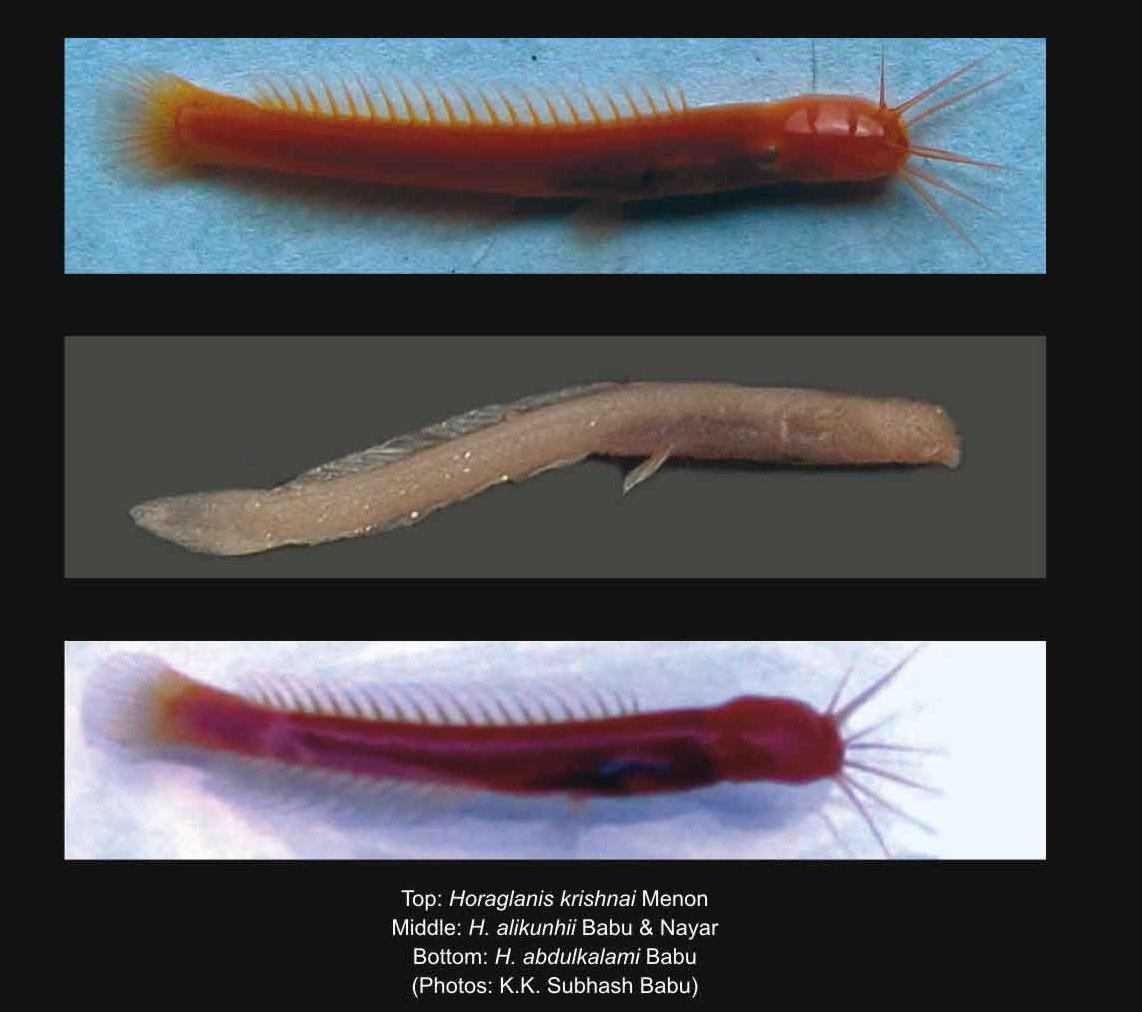 |
| Horaglanis krishnai, Horaglanis alikunhii and Horglanis abdulkalami |
According to the research paper published in an Indian
journal regarding the discovery, the new species is physiologically different from
the two known blind cat fish species - H.
Krishnai and H. alikunhii.
Gill membrane
of the newly found fish is free at the base of the isthmus. They are united
only half distance towards the tip of the lower jaw from the base. Moreover, the
presence of 13 brancheostegal rays and the 21 unbranched rays on the dorsal fin
also makes it different from other known species. In addition, the newly
identified fish has a rounded caudal fin with 28 rays with six of them
branched.
The new fish is 3.8 cm long and was red blood in colour when
first collected. Like similar species, H.
abdulkalami is also blind, an adaptation for its dark subterranean habitat,
says researchers.
According to Dr. K K Subhash Babu who has collected the fish
and described it, the fish still retains respiration through the skin. “With
help of Scanning electron microscope (SEM), we can see its body with full of
pores, especially head region. Apart
from its gills respiration, they can respire through its skin also. It is very
common with all newly hatched fishes which slowly turn to gill respiration. But
H. abdulkalmi, seems to retain this
capacity”, says he.
Missile Man connection of H. abdulkalami
 |
| Illustration showing pectoral and pelvic fin of H. abdulkalami |
According to the researcher, he has decided to name the new
discovery after Kalam, whom he found inspiring as a researcher. “When I was in
Cochin University, I wrote to him about this fish and my intention to give his
name to this remarkable fish and he very much appreciated my work”, he said.
Presently an Assistant Professor at the Department of
Biology at University of Jimma in Ethiopia, Dr. K K Subhash Babu shares the credit
of describing another blind catfish under the same genus – Horglanis alikunhi with another researcher.
The new discovery now adds to our limited knowledge of the
unexplored word of subterranean eco system of the Western Ghats.
Rare frog spotted from Western Ghats again
short URL for this story:- http://goo.gl/eUAG5
A rare frog believed to be found only in a specific part of
the Anamudi summit in Eravikulam National Park in the Indian state of Kerala
has been spotted from Poovar, a part of Western Ghats hill ranges some 20
kilometers away from the place of its earlier report.
 |
| Resplendent Bush Frog, (Raorchestes resplendens) |
According to a research correspondence published in the latest issue of
the Journal of Threatened Taxa, the new record is approximately 20 kilometer
away from the peak in the in north east direction, but within the boundary of
the same national park. The researchers have made an unexpected confrontation
with the frog during the survey of the endangered Nilgiri Tahr (Nilgiritragus
hylocrius) present in Eravikulam National Park.
Known as Resplendent
Bush Frog, (Raorchestes resplendens), the rare frog is categorized as critically
endangered by IUCN Amphibian Specialist Group. It was first reported in 2010 by a team of
researchers including the famous batrachologist Biju from Anamudi peak, which is
the highest peak in the state of Kerala.
The elusive frog which has brightly colored reddish orange
upper side was found in the grass land region in Poovar which is similar to the
habitat from which it was first found. According to the correspondence, the
frog was spotted inside a grass clump.
Conservation significance of the new findings
The new finding important as it gives valuable information about the
range of distribution of the species, which is significant in the conservation
of the species. When the frog was first found and described, it was believed
that it had a very restricted presence and is found only within a 3 square
kilometer area. However, the new finding reveals that the range of distribution
of the frog is actually more than 3 square kilometers.
“It is likely that R. resplensens may be more widespread in the
high altitude primary grasslands of Eravikulam National Park and surrounding
areas of the Western Ghats, than it was earlier thought.”, says the
correspondence.
In 2010, when it was
first spotted, researchers searched in nearby places, but failed to find the
frog from different habitats in the vicinity. This has made them believe that
the frog is present in only one type of locality in a small range.
In the present spotting, the most adjacent shola forest
patch was one kilometer away, which means that the frogs may be living in the
grass land itself. However, the first observations on Resplendent Bush Frog have revealed that the frogs use bamboo thickets in
the vicinity to burrow their eggs. Thus the grassland sholas and related bamboo
thickets at Eravikulam may be significant in a conservation perspective.
When it was first found in 2010, it was named Raorchestes to honour C. R.
Narayan Rao, a pioneering batrachologist in India. The resplendens name was given for the
splendid colour of the frog. According to researchers, this rare frog is
notable for its color as well as short limbs also.
Subscribe to:
Posts (Atom)