Restricted to the Western Ghats of India and parts of
Central Sri Lanka, Hump Nosed Pit Viper loves spending day in the leaf litter
on the forest floor. This snake is a perfect example for camouflage, since spotting it in the leaf litter on the forest floor is a difficult task.

News and updates about Indian Biodiversity Conservation.
Updated research findings and conservation measures about Indian biodiversity.
Showing posts with label Peppara wildlife sanctuary. Show all posts
Showing posts with label Peppara wildlife sanctuary. Show all posts

Wayanad Keelback: An Endemic Snake from Southern Western Ghats Video
e
Wayanad Keelback (Amphiesma monticola) is a non-venomous snake endemic to western Ghats. We found it on the way to Agasthyarkoodam, in Peppara Wildlife Sanctuary in Kerala, India. It was resting on the side of the road, after the area was swept out by a large forest fire. The tribal tracker (who was a member of the kani tribe) with us, said that they call this snake - Padakootti(someone who can gather forces) - and believes that if somebody mess up with one snake, he/she will come back with a lot of snakes.
However, herpetologists from Kerala suggest that the local name could be a mistake by the tracker.
Watch more Wildlife Videos from India's deep forests in our YouTube Channel.
Unethical wildlife photographers new threat to Slender Loris in South India
 |
| Slender Loris (Loris lydekkerianus) Image Courtesy: Kalyan Varma |
By surveying Kani tribes in Peppara wildlife sanctuary in Kerala and by analysing photos in a major Indian wildlife
photography website, the study points out that unethical handling of Lorises
for wildlife photography is rampant in South India. The practice could be one
among the poorly documented threats to this smallest primate endemic to South India and Sri Lanka, says the study.
Slender Loris is a nocturnal primate, found
in two subspecies- (Loris lydekkerianus
and Loris malabaricus) in South India
which are active only in the night and spend their whole day sleeping round as
a ball. The nocturnal nature of these slow loris keeps it elusive and less accessible to wildlife
tourists and wildlife photographers alike.
Arrange
Loris photo-shoots, get paid!
According to the study, wildlife photographers
in Thiruvananthapuram - the capital city of Kerala- pay Rs. 500 to 1500 to the indigenous Kani tribes
in the areas to capture Slender Lorises and arrange photo shoots. The practice
occurs despite the fact that the animal is protected under Schedule I of The Indian Wildlife (Protection) Act, 1972.
Apart from capturing and keeping it, the Lorises are often tightly held on short branches and prodded so that it won’t
move during a photo shoot; to help the ‘professional wildlife photographer’ get enough good pictures. Moreover, the poor animal will be illuminated with
torches aimed at it, says the study. It is a known fact that aiming strong
light sources like torches and camera flashes at Slender Lorises for longer, will be irritating to the
animal since it has very sensitive, large eyes to help their nocturnal life.
The study team has also noted that the animal
captured for such photo shoots are not returned to the place from it was
collected. In one incident, to which the team was witness, the animal was released
next day to an isolated bamboo clump near the house, after the photographer
getting enough pictures. The bamboo clump had no vegetation continuity to reach
back to the place from which the Loris was collected, says the study.
As per accounts of the tribes, it is usual to get Loris with infants which are again treated the same way. Another respondent, says the study, has cut down at least four trees to restrict a Loris to a single tree so that it will not escape.
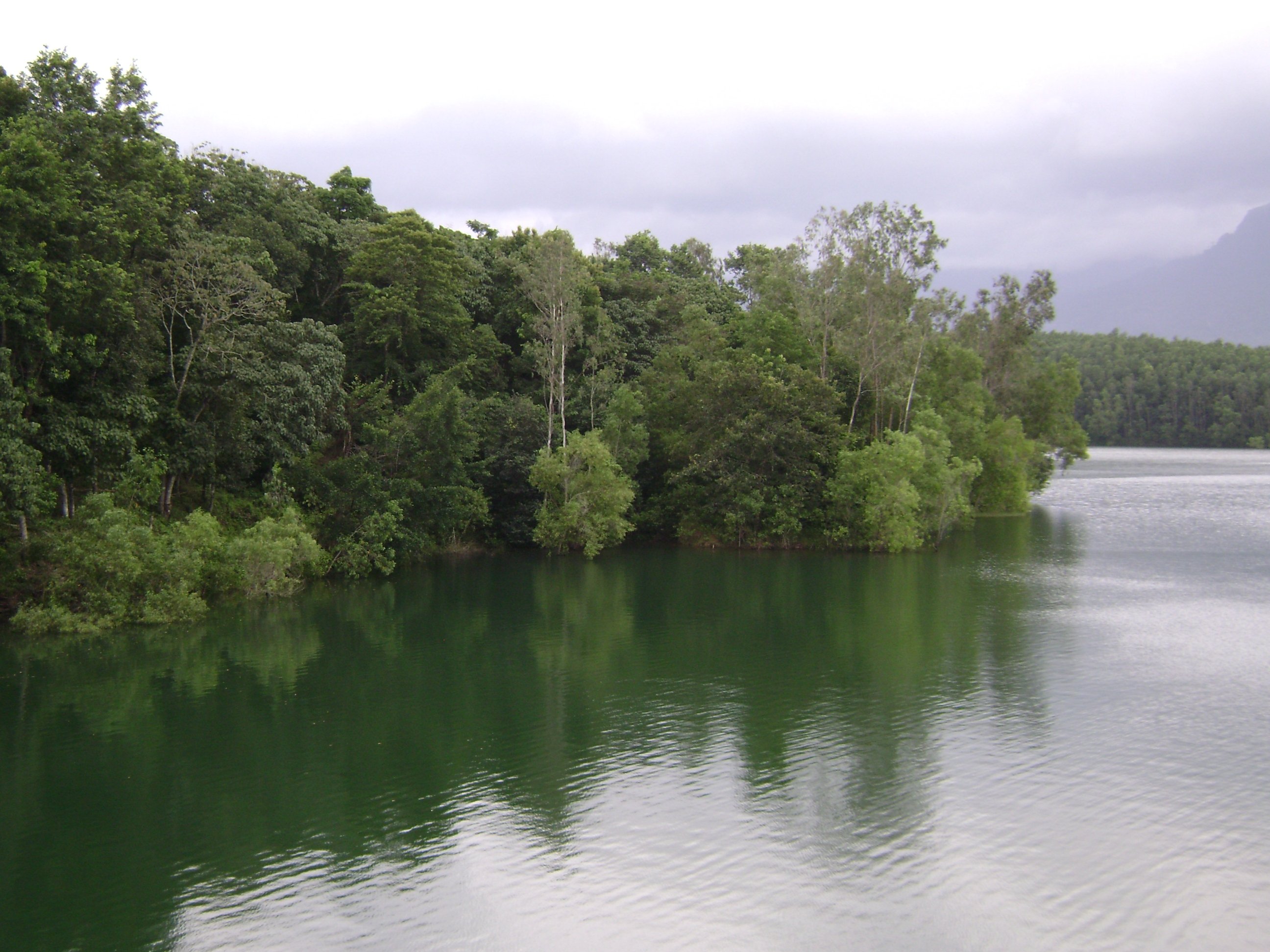 |
Peppara Wildlife Sanctuary As seen from the dam
Shadow auror at English Wikipedia [GFDL or CC-BY-SA-3.0-2.5-2.0-1.0], via Wikimedia Commons |

As per accounts of the tribes, it is usual to get Loris with infants which are again treated the same way. Another respondent, says the study, has cut down at least four trees to restrict a Loris to a single tree so that it will not escape.
The research team has also noted that the
tribes are so much familiarized with the practice that they hold the animal in
different ways to help the photographer get very good angles.
It was while studying about the status of forest dwelling chelonians in Agasthyamalai region, that the research team came to notice the unethical wildlife photography practices.Arun Kanagavel, Rajkumar Sekar and Rajeev Raghavan of Conservation Research Group (CRG), St. Albert’s College, Cochin, and Cynthia Sinclair of Wildlife Information Liaison Development Society (WILD), Zoo Outreach Organization were part of the study team.
It was while studying about the status of forest dwelling chelonians in Agasthyamalai region, that the research team came to notice the unethical wildlife photography practices.Arun Kanagavel, Rajkumar Sekar and Rajeev Raghavan of Conservation Research Group (CRG), St. Albert’s College, Cochin, and Cynthia Sinclair of Wildlife Information Liaison Development Society (WILD), Zoo Outreach Organization were part of the study team.
Money
matters. well, more than tradition
However, from the study, it can be found
that the tribes are not completely unaware of the conservation angle
traditionally. Informal interviews with the kani tribes reveals that the tribes
otherwise don’t prefer catching this insect eating, slowly moving primate,
since it is believed to resemble their hill god (mala daivam). Connecting such organisms
with the divine was an old, time-tested traditional trick of nature conservation
in the Asian countries. The tribes also don’t keep Loris as pets since its
looks are unpopular. They often consider it a bad luck to sight a Loris in the
forests. Despite these beliefs, the money offered by photographers are luring the tribes to indulge in this unethical practices against their traditional
beliefs.
Actually, the tribes take extra pain to do
the business. According to the accounts, painful bites are a usual while
capturing the primate. When kept in home, the animal has to be covered under
clothes to avoid women in the house seeing it, since unmarried woman having a look at the Loris will stay a spinster
throughout the life, as per traditional belief.
The
cyberspace connection
To study the trend deeply, the research
team has also surveyed the Loris photos available on a major Indian wildlife
photography portal. They have found that majority of the pictures were taken
during day time, with the animal in awakened position, often hinting blatant ill-treatment.
Out of the 28 cases they have studied, 16
involved mistreating the animal. 13 photographs of this nocturnal animal were
taken during day. According to the study, the incidents of the unethical
practice were more sighted in photographs taken from Karnataka.
Ethical
aspects of Wildlife photography
The ethical guidelines in wildlife
photography discourage forcing an animal from its natural conditions to get
favorable pictures. Altering the habitat of an animal to get beautiful pictures
is anything beyond the ethical grounds of wildlife photography. However, it is
unfortunate to notice that majority of the wildlife photographers – both
professional and matures- are less concerned about such ethical aspects of the
trade.
“It is not this species alone that is facing threat. Instances of unethical photography inside the wildlife sanctuaries and core areas are growing,” said Balan Madhavan, wildlife photographer and a member of the International League of Conservation Photographers.According to him, Wildlife photography is part of nature conservation but these unethical practices by certain people are marring the very essence of it.
"(Most of ) those people engaged in this unethical practice are doing it for popularity. They are less concerned about wildlife or its conservation and are uploading those photos on social networking sites", said he. It is time to bring some kind of regulation to such unethical practices, he added.
Other
Threats to Loris
However, the wildlife photographers are just
an addition to the threats to the existence of this endemic primate. Earlier studies have revealed that astrologers
in South India use it for picking tarot cards. Like the Slow Loris, pet trade target Slender Loris also. Practitioners of Traditional medicine also prefer loris since it is
believed to have medicinal properties to treat a variety of ailments including leprosy . Some traditional medical practitioners also use
the tears from Slender Loris to treat eye ailments and to prepare love potions. Illegal capturing and
trading of lorises for all these purposes is a major threat to the life of this
animal.
Striated Fivering spotted after 90 years in India during Neyyar WLS butterfly survey
Thiruvananthapuram: Butterfly researchers were stunned when
they accidentally met and photographed Striated Five-ring (Ypthima striata ), a rare butterfly from Neyyar Wildlife Sanctuary
in Thiruvananthapuram district of Kerala during a recent butterfly survey, since the last records of this small butterfly
from India dates back to 19th century.
Now watch two mating Common Fivering butterflies after the break.
 |
| Image Courtesy: Indian Foundation for Butterflies |
According to Dr. Kalesh Sadashivan, a butterfly expert and
PRO of Travancore Natural History Society (TNHS), the record is the first one after
90 years, when the butterfly was last reported from Nilgiri by British collectors.
“The highlight of the survey was the
discovery of the Striated Five-ring by Dr. Kunte and Dr.Milind which is the only
known record in the country in the last 90 years. It was never found after
it was collected from the Nilgiris in the last century”, says a post in the
official group of TNHS in Facebook.
The butterfly was spotted near Venkulamedu near Anainirathy base camp inside Neyyar Wildlife Sanctuary by a team lead by Dr. Krushnamegh Kunte
and Dr. Milind Bhakare during the survey. The
photographs made by the survey team which are available Indian Foundation for Butterflies, could be the first live pictures of the rare
butterfly from India.
Historical records show that G F Hampson has mentioned about
the butterfly in his “Butterflies of the Nilgiri District”, published in 1888.
According to his accounts, he collected a male specimen of the butterfly from Nilgiris
at 5000 ft on August 25th of 1888. He has mentioned the habitat of the
butterfly as the southern slopes of the Nilgiris with an elevation of 2000 to
4000 ft.
According to Dr. Kunte, the new discovery is very important since
the first record is from north of the Palghat gap and is some 500 to 600
kilometers from the latest report. Thus the new record indicates that the
actual distribution of Striated Five-ring is not just restricted to Nilgiris.
Apart from the record of Striated Five-ring, the survey
teams have also spotted Joker, an elusive butterfly which has been reported just
twice from Kerala during the last 120 years.
239 butterfly species
identified at Peppara and Neyyar WLS
According to sources, the survey
has recorded a total of 239 butterfly species among which 22 are found only
from Western Ghats from Peppara and Neyyar WLS together. The teams has reported 186 species of butterfly species
from Neyyar WLS and 153 species at Peppara WLS. The findings of the survey may
be published into a booklet detailing the butterfly diversity of Peppara and
Neyyar Wildlife Sanctuaries, said sources.
The three-day
butterfly survey was jointly conducted by Kerala Forest Department and Travancore Natural
History Society during December 14th to 16th. According to TNHS, More than 30 volunteers from different parts of the country
took part in the survey.
Now watch two mating Common Fivering butterflies after the break.
Subscribe to:
Posts (Atom)