Blackbuck (Antilope cervicapra) is the fastest running antelope in India. Here you may watch a herd of female and young blackbucks at Ranebennur Blackbuck Sanctuary in Haveri district of the Indian state of Karnataka.

News and updates about Indian Biodiversity Conservation.
Updated research findings and conservation measures about Indian biodiversity.
Showing posts with label Karnataka. Show all posts
Showing posts with label Karnataka. Show all posts
Blackbuck herds in Blackbuck Sanctuary, Ranebennur - HD video
Blackbuck (Antilope cervicapra) is the fastest running antelope in India. Here you may watch a herd of female and young blackbucks at Ranebennur Blackbuck Sanctuary in Haveri district of the Indian state of Karnataka.

Tiger Population in India shows 30.5 percent increase in 2014
 |
| A tiger under captivity in a zoo in Mangalore, Karnataka. |
As per the latest estimates released by the Ministry of Environment and Forests, the number of tigers found in the wild, in India increased from 1706 in 2010 to 2226 in 2014. The new figures shows that there is a 30.5 percent increase in the tiger population compared to the last estimate. The results of the survey show that states like Karnataka, Uttarakhand, Madhya Pradesh, Tamil Nadu, and Kerala marked an increase in the tiger population.
According to the press release issued by Press Information Bureau, the figures were released by Prakash Javadekar, Minister of Environment, Forests and Climate Change in the inaugural address at the two day meeting of the Chief Wildlife Wardens of Tiger States and Field Directors of Tiger Reserves. According to the minister conservation efforts related to Special Tiger Protection Force, Special Programme for Orphan Tiger cubs, efforts to control poaching and initiatives to minimize Human-Animal conflict and encroachment have resulted in the growth of tiger population in the country.
The figures are derived from a comprehensive survey of 18 Tiger States, covering an area of 3,78,118 sq.kms of Forest Area. The double sampling procedure used in the survey, using camera traps made a total of 1540 unique Tiger Photo captures.
“The third round of independent Management Effectiveness Evaluation of Tiger Reserves has shown an overall improvement in the score of 43 Tiger Reserves from 65% in 2010-11 to 69 in 2014”, says the release. Moreover, the forest cover assessment also indicates improvement. “The assessment of Forest Cover Change in Tiger Landscape of Shivalik-Gangetic Plain has indicated an improvement of forest cover in core areas of Tiger Reserves”, says the release.
Wild Elephants in the Nilgiris help seed dispersal of fruit bearing plants: reveals new study
 |
| Elephant herds in Silent Valley National Park in Western Ghats of Kerala (Photo Courtesy: N P Jayan) |
Wild tuskers in Southern Western Ghats are
just like birds. Not that they can fly, but like their winged friends,
they play a crucial role in the seed dispersal of some plant species
found in this rare biodiversity hotspot, says researchers who
studied the seed dispersal role of elephants here.According to their study, Asian elephants (Elephas maximus) are important seed
dispersing agents of some fruit bearing plants in the semi-deciduous, thorny
forests of the Nilgiri Biosphere Reserve, the oldest biosphere reserve in India which lies in the Western Ghats.
By examining the fruit seeds and remnants in
elephant dung piles in the study areas, the researchers found that this biggest
terrestrial animal plays a key role in the seed dispersal of at least eight
different plant species found in the area like Acacia intsia (Twisted Acacia),
Artocarpus heterophyllus (Jack Fruit),
Bauhinia racemosa (Bidi Leaf Tree),
Grewia hirsuta (Kukurbicha), Grewia
tiliifolia (Dhaman), Mangifera indica
(Mango), Tamarindus indica (Tamarind) and Ziziphus
mauritiana (Indian jujube). Among these eight, Wild Tamarind and Twisted
Acacia are the favorite fruit of the tuskers, since their presence was significantly more in the dung piles than the other six species, says the study which is published in the Journal of Threatened Taxa.
Earlier research in Asian and African forests have shown that elephants are a very effective seed dispersing agents. They devour huge amount of fruits and carry the seeds to long distances from the parent tree with their behavior of moving to wide-ranging areas. Moreover, seeds are defecated intact. It is also observed that the dung piles often provide a nutritious medium for seed germination.
Fruit
Diet of the Pachyderms in the Nilgiris
The study has also revealed some
interesting insights into the food habits of the wild elephants in Nilgiris.
According to the researchers, elephants in the area consume more fruits during
dry season when compared to the wet monsoon season. “Seeds and other fruit
parts appeared in the dung piles significantly more frequently during the dry
season than in the wet seasons”, says the study.
Moreover, tuskers prefer a fruity diet more
in the thorny forests, than in a moist deciduous area, shows the results of the
study. The study also confirms the sometimes notorious truth of the tuskers’ irresistible
temptation for mango and jack fruits when they are in moist deciduous areas in
NBR. Remnants of both of these fruits were frequently found in the dung piles
from moist deciduous areas. Often, fruiting jack fruit trees are blamed for
wild elephants raiding villages in the forest fringes of NBR.
However, pachyderms have dislikes for certain
items in their fruits menu, says the study. Fruits of Z. mauritiana are less preferred by these animals, as indicated by
the lower presence of these fruit remnants in the dung piles, despite the wide presence of the plant in the forests of NBR.
But don’t misunderstand that the wild elephants
in Western Ghats consider fruits as their favorite item like their African and
Malayan counter parts, reminds the researchers. Grass species like bamboo are
the first preference for tuskers in these areas. Fruits are second or third in
the list. “Elephants consume a lesser number of fruit species in the tropical
dry forests of Nilgiri Biosphere Reserve than in the rainforest habitats of
Asia and Africa”, points out the study.
Asian
Elephant Population in the Nilgiris
The study was carried out in Mudumalai
Wildlife Sanctuary which is presently a Tiger Reserve, Nilgiri North,
Sathiyamangalam and Coimbatore forest divisions, Bandipur Tiger Reserve and
Wayanad Wildlife Sanctuary which all come under Nilgiri Biosphere Reserve.
According to the figures of the last
elephant census, the area holds the one of the largest population of Asian
elephants in the world, with approximately 4,500–5,800 individuals.
During the study period, the research team
extensively followed elephant herds and bulls in these areas. According to the
researchers, they have collected fresh dung piles whenever defecation was
observed. On a total, they have examined 455 elephant dung piles during the
whole study period.
Nagarajan Baskaran and Ajay A. Desai of Bombay Natural History Society have co-authored the study.
Protected Areas Not Always Harbour Crop Raiding Animals, Says Study on Indian Tiger Reserves
 |
| Indian Leopard (Panthera pardus fusca) Image Credit: Kalyan Varma |
Crop raiding by
wild animals is a major issue that triggers human animal conflict and
retaliatory killing in many parts of the country. But a new study about the
human animal conflict around Protected Areas (PAs) in the country shows that
protected areas not necessarily act as a source of crop raiders always. The
finding is significant at a time when the establishment of new protected areas are
opposed by sections of public and politicians saying that it will intensify the
menace of crop raiding.
A survey
conducted among 398 households which are situated within 10 kilometers of three
major tiger reserves in the country – Ranthambhore, Kanha and Nagarhole – found
that the rate of crop loss from crop raiders did not vary with the proximity to
the PAs, showing that protected areas are not always sources for crop raiders.
“This (the
results) may suggest crop raiders may not be limited to animals coming out from
the PA, and perhaps some raiders may naturally reside outside the PAs”, says
the study. Instead of the proximity, it is the forage availability that has
increased the chances of crop loss in all these PAs, shows that results of the
study, which is published in the Environmental Management Journal. “Factors
related to forage availability for wildlife- the number of harvests per year,
share cropping (growing crops on someone else’s land), number of crops per year
and cropping months in a year all increased risk”, it says.
Analyzing the
effectiveness of the mitigation efforts, the study found that two mitigation
efforts – fencing and the use of guarding animals were most effective in decreasing
risk of crop loss from crop-raiding animals.
Livestock Loss near Tiger Reserves
Loss of
livestock is another major cause for human animal conflict near protected areas in India. During the study, 13
percent of the households reported cattle loss from wild animals. Though tiger,
Hyena, dhole (Cuon alpinus), Jackal, wild pig and even macaques were blamed fro
livestock loss, leopard was identified as the most damaging.
However, statistically
examining the reasons, the study found that complaints of
carnivores attacking livestock or human were more associated with people
grazing animals and collecting forest produces from inside the protected areas.
“Respondents reported that
livestock losses occurred inside the PAs during the day, and fewer incidents
occurred at night when the livestock were corralled near their homes or
villages”, finds the study.
According to the
findings of the study, simply stopping animal grazing inside the protected
areas under study may decrease the rate of livestock loss. However, it heavily
depends on the availability of grazing area outside the PAs.
Hostility towards animals
Contrary to the
wide belief that people are hostile towards carnivores that attack the
livestock, the study found that people are more hostile towards herbivores like
wild pig which cause damage to crops. “Households reported greater inclination to kill
herbivores destroying crops or carnivores harming people, but not carnivores
preying on livestock”, says the study.
 |
| Wild Boar (Sus scrofa) Image Credit: Kalayan Varma |
However, the hostility
towards animals was different in the three tiger Reserves in which the study
was carried out. According to the researchers, residents near Kanha National Park
showed more inclination towards killing the problem animals as a solution to
the hypothetical situations put in front of them, despite the lowest reported
livestock deaths from this area.
Residents near Ranthambhore National Park and
Nagarhole National Park preferred to frighten or deter the animals.
Flawed Compensation Policies
Monetary
compensation from wildlife officials is one of the major ways to suppress possible
retaliatory killing of animals by people in areas of human animal conflict. However,
the study found that 99 percent of the households which participated in the
study received no compensation from authorities for losses. “There is an urgent need to corroborate losses reported
by local residents to official records to identify gaps and improve
compensation distribution to households reporting losses”, says the study.
Krithi K.
Karanth and Ruth DeFries from Columbia University, Lisa Naughton-Treves from
University of Wisconsin and Arjun M.
Gopalaswamy from University of Oxford co-authored the study.
Six injured Slender Lorises rescued from Bangalore city, black magicians suspected
.jpg "Slender Loris (Loris lydekkerianus)") |
| Slender Loris (Loris lydekkerianus) Image Courtesy: Kalyan Varma |
Wildlife smuggling rackets and black magicians are on the
prowl in Bangalore, hints recent wildlife rescues from the city. Officials were
able to save six severely injured Slender Lorises- a slow-moving, nocturnal
primate- in the last two months. All of them are suspected to be smuggled into
the city and were tortured by black magicians.
According to People for Animals (PFA), an NGO involved in
rescuing animals, all the rescued Lorises were injured in a specific way. The
activist of the NGO alleges that the nature of the wound found on these rescued
animals show that they are being used by black magicians. Kishan C H, General
Manager of the Bangalore chapter of People for Animals told the media that the
animals are injured in the most barbaric way. According to reports, the animals
were in bad shape with their arms or legs crushed or cut off.
This smallest primate, found only in India and Sri Lanka, is
targeted by black magicians and folk medicine practitioners for the belief that
the animal has special powers and medicinal properties. “The belief is
that whatever is inflicted on the animal will in turn happen to the person's
enemy," said Kishan.
The NGO was able to spot the animals from different parts of
the city. While some of them were reportedly found from a farm house near
Nelamangala, one was taken to a veterinary hospital first and later reached
PFA. Rescuers were able to find two of the animals at Shivajinagar. Despite the
rescue efforts, three out of the six rescued animals were not able to survive.
The other three were later returned to the wild with the help of forest
officials, said PFA sources.
Smuggling Slender Loris
It is suspected that the trucks carrying wood from the outskirts
of the city would have been used to smuggle Slender Loris at least in Shivajinagar,
since it is the major center for carpentry in the city. According to M Nagaraj,
Forest Range Officer, South Bangalore, the forest officials have noted that the
use of Slender Loris for black magic is turning rampant in the city. “We have
already come across six instances in two months. We have not made any arrests
yet but are keeping a close watch on it”, he said.
Experts suspect that tribes are being paid for catching the
animals and handing over to smuggling rackets. It was earlier reported that
tribes are paid by photographers to catch Slender Loris to photograph it.
Texting facility to warn about elephant raids in forest-fringe villages developed
Unexpected elephant raids are the worst nightmare of a
forest-fringe village in India. But what if there is somebody to text you in
advance that the jumbos are on the way? Researchers in Tamil Nadu claimed to
have developed an intrusion detection system which can text forest officials an
early warning if an elephant heard is moving towards a village.
 |
| An Indian elephant in the wild: from Nagarhole National Park in Karnataka |
Texting an elephant raid warning
According to S. J. Sugumar of Coimbatore Institute of Technology and R. Jayaparvathy of SSN College of Engineering Chennai, who developed the system, it functions by tracking the movement
of the elephants electronically with the help of the vibrations on the ground
created by the footfall of the animal. The system, according to the
researchers, has to be implemented in “specific pockets identified based on the
analytical results along the forest border areas where the elephants can
intrude from the forest into human habitation.” It consists of a geophone
string, threshold comparator with amplification module, embedded micro
controller, GSM, and the power supply.
A research article published in
Current Science journal about the system says that the footfall of the elephant
produces a vibration in the ground which is sensed by the geophones that are
buried underground. After sensing the vibration, the geophone will generate an
electrical signal which will be amplified and compared with a set threshold
value which is based on that generated by the footfall of a single elephant. If
it exceeds the threshold, the system is designed to trigger the embedded
controller to send a warning SMS with the help of the GSM transceiver to the
forest officials. The geophones with a range of 120 square meters can cover a
large area when used as a string of five geophones, claim the researchers.
Impact on
human-elephant conflicts
 |
| Geo-phone as part of the elephant intrusion detection system (Image Courtesy: Current Science) |
The study was carried out in Coimbatore forest division
which has recorded a number of cases of human-elephant conflict. According to
official figures, there were 680 incidents of elephant intrusion into human
habitat in 2011 while it was 844 in 2010 and 560 in 2009. In 2011, 14 people
were killed in elephant attack while the figure was 16 in 2010 and 11 in 2009.
In the conflict, there was a reported death of 10 elephants in 2011, 11 in 2010
and 12 in 2009. The implementation of the system is expected to help bring down
the number of incidents of unexpected elephant raids and resulting causalities
on both sides.
However, there are chances that other heavy animals walking
over the buried geophones trigger false alarms. To avoid this
confusion, the researchers have identified four different types of possible
responses and have designed the system in such a way that false alarms are not
triggered. According to the researchers, on field trials, the performance of
the system to differentiate the vibrations generated by different species of
animals was 91.25 percent. Analyzing the migration data of elephants in an area can be well used to predict the possibilities of
intrusion almost precisely, say the researchers.
Biodiversity Conservation in India
India is home to
forests with rich wildlife. However, being the second most populated country in
the world, the enormous pressure of the exploding human population of the
country is shrinking the forests, wiping off the rich fauna and flora. To
conserve the remaining greenery and the rare life forms, India has made
efficient in-situ conservation programmes to conserve ecologically important
areas by regulating human intervention. These efforts have established a
protected area network in the country within this period.
Protected Area Network in India
Forests and
Wildlife are included in the concurrent list by the Indian constitution which
holds federal states responsible for implementing the policies formulated by the
Centre to conserve forests and wildlife. In India, the National Board for Wildlife
(NBWL) formulates the policy framework for forest and wildlife conservation.
The board, which is chaired by the Prime Minister, has formulated and adopted
National Wildlife Action Plan in 2002, which will extend till 2016.
 |
| A Sambar deer (Rusa unicolor) at Nagarhole National Park in Karnataka, India |
According to
Ministry of Environment and Forests (MoEF), India has 668 protected areas in
the country, as of 2010. However, they together constitute just 4.90 percent of the total
area of the country. Among these, 102 are National Parks, 515 are Wildlife Sanctuaries,
47 are Conservation Reserves and 4 are Community Reserves.
The terms are
indeed confusing and often rake up unnecessary issues when used by scaremongers.
What is a National Park?
According to
Wildlife (Protection) Act, 1972, a National Park should be an area with enough
ecological, geo-morphological and natural significance, obviously, with rich fauna
and flora. Central Government enjoys the freedom to declare any specific area
in the country a National Park, but often based on the recommendations made the
state governments. A National Park is declared to protect, to propagate and to
to develop wildlife or its environment. Actually the major difference between a
National Park and other protected areas is that the rights of the people living
inside the limits of a national Park are often tightly regulated. While grazing
by livestock inside a national park is strictly prohibited, removal of forest
produce needs recommendation from National Board of Wildlife.
What is a Wildlife Sanctuary (WLS)?
 |
| One of the peaks of Agasthyamalai ranges as seen from Neyyar Wildlife Sanctuary, Kerala |
Though a WLS is again an area with zoological, ecological and geomorphological importance and with rich fauna and flora, it has certain differences with National Parks and other protected areas in India. Despite the fact that it is declared by the Central Government to protect wildlife and to develop natural habitats, the rights of the people living inside the limits of the sanctuary differs very much from other PAs. Comparatively, people living inside the limits of a Wildlife Sanctuary have more rights than their counterparts within a National Park. It is also allowed that the District Collector, in consultation with the Chief Wildlife Warden may decide to allow the continuation of any right during the settlement of claims.
Conservation Reserves in India
Unlike NPs and
WLS, a conservation Reserve is declared by state governments. Usually the area
will be owned by the government and lies near to Wildlife Sanctuaries or
National Parks. These often function as a buffer zone for a protected area or a
link which connects two protected areas together. However, an area will be
declared as Conservation Reserve only after holding adequate consultations with
the local people. (In fact, that happens with the other PAs also.) There are no
regulations on the rights of the people living inside a Conservation Reserve.
Community Reserves in India
Again, declared
by state government, a Community Reserve can even be privately or community
owned land declared so when an individual or community volunteers to conserve
the area and its natural fauna and flora. Apart from protecting the natural
habitat and environment, Community Reserves may also protect cultural values
and practices related to the area. There are no regulations on the rights of
the people living inside a Community Reserve. Till date, there are only four
community reserves in the country - Kokkare Bellur Community Reserve in
Karnataka, Kadalundi- Vallikkunnu Community Reserve in Kerala (both are for
conserving birds), Lalwan Community Reserve and Keshopur-chhamb Community Reserves
in Punjab also.
You can have a look at the MoEF document about the protected area network below.
Biosphere Reserves (BRs)
Biosphere
Reserves are another term which often pops up when it comes to biodiversity
conservation in India. However, unlike NPs, WLS and Community or Conservation Reserves,
BRs are larger in their areas, and are not formed according to the provisions
of the Wildlife (Protection) Act, 1972.
According
to MoEF, BRs are “areas of terrestrial and coastal ecosystems which are
internationally recognized within the framework of the Man and the Biosphere
(MAB) programme of the UNESCO.” Thus, Biosphere Reserves may have one more
national parks or Wildlife Sanctuaries in it.
While
National Board of Wildlife is the apex body to decide on National Parks, The
Indian National Man and Biosphere (MAB) Committee constituted by the MoEF is
the apex body in the case of BRs in the country.
In
India, the programme was started in 1986, with which so far, 18 sites have been
declared as Biosphere Reserves (BRs). However,
out of the 18 BRs, only eight has been accepted as part of the World Network of
Biosphere Reserves of UNESCO. They are
1. Nilgiri
(Tamil Nadu, Kerala and Karnataka)
2. Gulf of Mannar (Tamil Nadu)
3. Sunderban (West Bengal)
4. Nanda Devi, (Uttarakhand)
5. Pachmarhi (Madhya Pradesh)
6. Similipal (Odisha)
7. Nokrek (Meghalaya)
8. Achanakmar-Amarkantak (Chhattisgarh and Madhya Pradesh)
2. Gulf of Mannar (Tamil Nadu)
3. Sunderban (West Bengal)
4. Nanda Devi, (Uttarakhand)
5. Pachmarhi (Madhya Pradesh)
6. Similipal (Odisha)
7. Nokrek (Meghalaya)
8. Achanakmar-Amarkantak (Chhattisgarh and Madhya Pradesh)
India has submitted a revised
nomination for Great Nicobar (Andaman & Nicobar Islands) also.
You can have a look at the MoEF document about the protected area network below.
North American weed spotted in India, could be major threat to agriculture and forests in future
 |
| Western ragweed (Ambrosia psilostachya) Image courtesy: Krzysztof Ziarnek Kenraiz (Wikimedia commons) |
Its Indian variety, Ambrosia
artemisiifolia, was the only member of the genus hitherto reported from
India. According to the correspondence, the new weed is native to North America
and is known as perennial rag weed or western ragweed in North America.
New invasive plant threat
in India
The research note warns that the weed has tremendous
capacity to spread very rapidly and is known to cause allergic reactions in Humans.
“If the weed is not controlled now, it may create a difficult to control
situation once it proliferates from the location of present report”’ says the
correspondence.
According to the correspondence, the weed has not only
invaded finger millet, mulberry, coconut and areca nut cultivation but has also
conquered the cattle pastures which have affected animal husbandry of these
villages. The correspondence also notes that the plant has seriously affected
local flora, by replacing local grass varieties, thus decreasing fodder
availability.
The plant is capable of spreading to large areas through
extensive vegetative reproduction through underground rhizome like roots and
stolon (part of the plant which makes new plant). Though the plant has been present in some
villages in Karnataka for the last 15 to 20 years, it is not yet clear what
restricts it from spreading to other places.
According to the
researchers, since the plant does not have parts which supports seed dispersal
through wind, the plant has not yet started spreading to other places. It is
also not clearly known at this point if all the seeds produced by the plant are
viable or if they exhibit any type of dormancy.
Though, there are not many issues reported about this plant
expect its rapid invasion of farm lands in Karnataka Villages, reports from
other countries indicate that the plant can cause allergic diseases in humans.
“The species is said to be responsible for causing severe allergenic diseases
in human beings in the United States”, says the correspondence.
The North American
Connection
The plant is actually native to North America and the way in
which it has reached Indian farmlands is still unknown. Though some speculates
that the seeds could have been brought to India by migratory birds that use the
seeds and other parts the plant for making nests, the connection is yet to be
scientifically proved.
Though contaminated food grains are a usual way in which invasive plants reach farther places -as in the case of Lantana, a notorious
weed in Indian forest- that may not be the reason for the spread of the present
weed. “The introduction of the species through contaminated food grain may not be
possible, as the weed is localized only in these villages in Karnataka”, says
the paper.
The plant has already spread to parts of South America,
Europe, New Caledonia, Japan, Taiwan and Australia. The researchers do not rule
out the chances that the seeds reaching India from either of these places.
Weed control measures
Read more on IBT's coverage on invasive species in India.
Unethical wildlife photographers new threat to Slender Loris in South India
 |
| Slender Loris (Loris lydekkerianus) Image Courtesy: Kalyan Varma |
By surveying Kani tribes in Peppara wildlife sanctuary in Kerala and by analysing photos in a major Indian wildlife
photography website, the study points out that unethical handling of Lorises
for wildlife photography is rampant in South India. The practice could be one
among the poorly documented threats to this smallest primate endemic to South India and Sri Lanka, says the study.
Slender Loris is a nocturnal primate, found
in two subspecies- (Loris lydekkerianus
and Loris malabaricus) in South India
which are active only in the night and spend their whole day sleeping round as
a ball. The nocturnal nature of these slow loris keeps it elusive and less accessible to wildlife
tourists and wildlife photographers alike.
Arrange
Loris photo-shoots, get paid!
According to the study, wildlife photographers
in Thiruvananthapuram - the capital city of Kerala- pay Rs. 500 to 1500 to the indigenous Kani tribes
in the areas to capture Slender Lorises and arrange photo shoots. The practice
occurs despite the fact that the animal is protected under Schedule I of The Indian Wildlife (Protection) Act, 1972.
Apart from capturing and keeping it, the Lorises are often tightly held on short branches and prodded so that it won’t
move during a photo shoot; to help the ‘professional wildlife photographer’ get enough good pictures. Moreover, the poor animal will be illuminated with
torches aimed at it, says the study. It is a known fact that aiming strong
light sources like torches and camera flashes at Slender Lorises for longer, will be irritating to the
animal since it has very sensitive, large eyes to help their nocturnal life.
The study team has also noted that the animal
captured for such photo shoots are not returned to the place from it was
collected. In one incident, to which the team was witness, the animal was released
next day to an isolated bamboo clump near the house, after the photographer
getting enough pictures. The bamboo clump had no vegetation continuity to reach
back to the place from which the Loris was collected, says the study.
As per accounts of the tribes, it is usual to get Loris with infants which are again treated the same way. Another respondent, says the study, has cut down at least four trees to restrict a Loris to a single tree so that it will not escape.
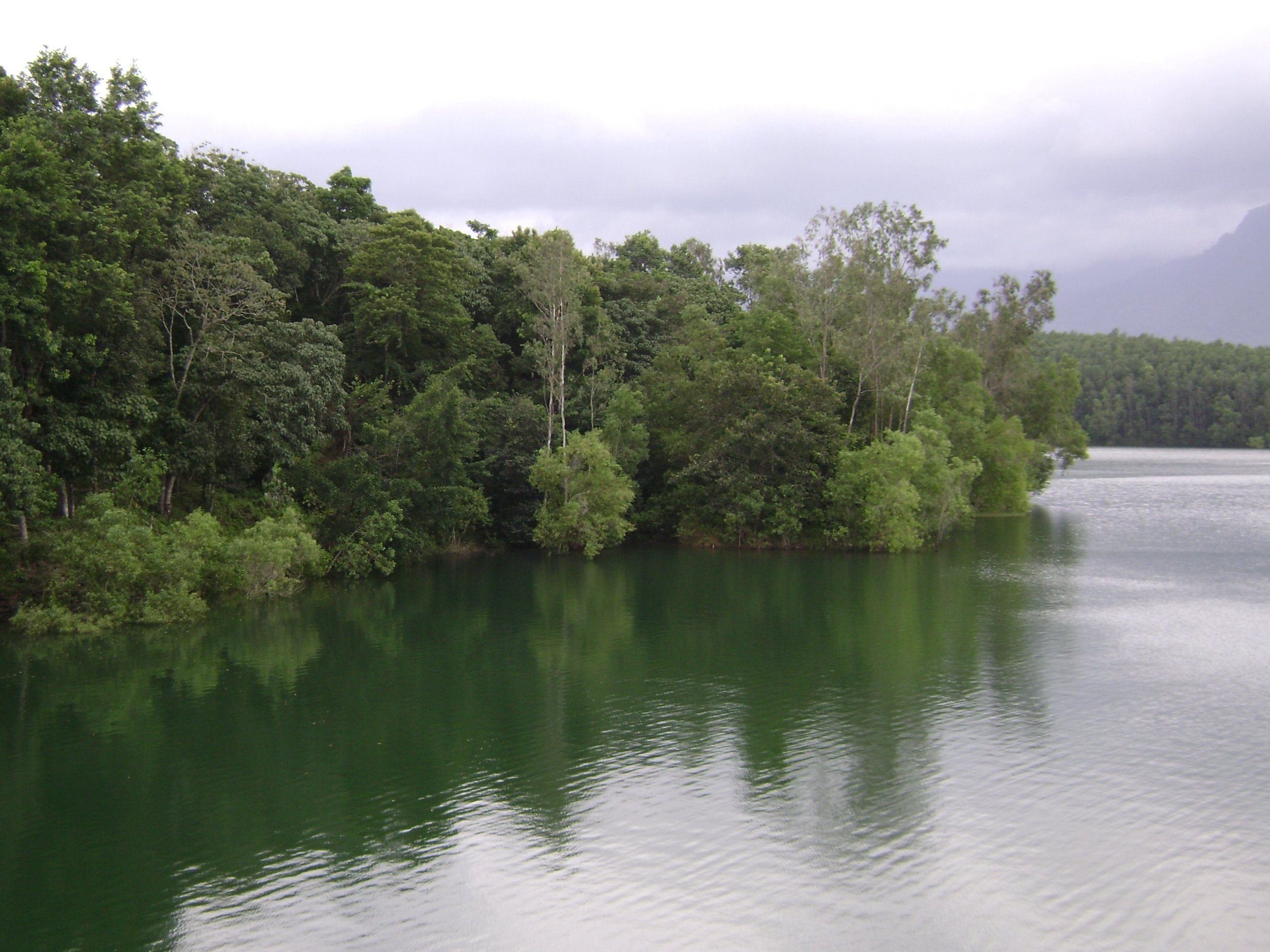 |
Peppara Wildlife Sanctuary As seen from the dam
Shadow auror at English Wikipedia [GFDL or CC-BY-SA-3.0-2.5-2.0-1.0], via Wikimedia Commons |

As per accounts of the tribes, it is usual to get Loris with infants which are again treated the same way. Another respondent, says the study, has cut down at least four trees to restrict a Loris to a single tree so that it will not escape.
The research team has also noted that the
tribes are so much familiarized with the practice that they hold the animal in
different ways to help the photographer get very good angles.
It was while studying about the status of forest dwelling chelonians in Agasthyamalai region, that the research team came to notice the unethical wildlife photography practices.Arun Kanagavel, Rajkumar Sekar and Rajeev Raghavan of Conservation Research Group (CRG), St. Albert’s College, Cochin, and Cynthia Sinclair of Wildlife Information Liaison Development Society (WILD), Zoo Outreach Organization were part of the study team.
It was while studying about the status of forest dwelling chelonians in Agasthyamalai region, that the research team came to notice the unethical wildlife photography practices.Arun Kanagavel, Rajkumar Sekar and Rajeev Raghavan of Conservation Research Group (CRG), St. Albert’s College, Cochin, and Cynthia Sinclair of Wildlife Information Liaison Development Society (WILD), Zoo Outreach Organization were part of the study team.
Money
matters. well, more than tradition
However, from the study, it can be found
that the tribes are not completely unaware of the conservation angle
traditionally. Informal interviews with the kani tribes reveals that the tribes
otherwise don’t prefer catching this insect eating, slowly moving primate,
since it is believed to resemble their hill god (mala daivam). Connecting such organisms
with the divine was an old, time-tested traditional trick of nature conservation
in the Asian countries. The tribes also don’t keep Loris as pets since its
looks are unpopular. They often consider it a bad luck to sight a Loris in the
forests. Despite these beliefs, the money offered by photographers are luring the tribes to indulge in this unethical practices against their traditional
beliefs.
Actually, the tribes take extra pain to do
the business. According to the accounts, painful bites are a usual while
capturing the primate. When kept in home, the animal has to be covered under
clothes to avoid women in the house seeing it, since unmarried woman having a look at the Loris will stay a spinster
throughout the life, as per traditional belief.
The
cyberspace connection
To study the trend deeply, the research
team has also surveyed the Loris photos available on a major Indian wildlife
photography portal. They have found that majority of the pictures were taken
during day time, with the animal in awakened position, often hinting blatant ill-treatment.
Out of the 28 cases they have studied, 16
involved mistreating the animal. 13 photographs of this nocturnal animal were
taken during day. According to the study, the incidents of the unethical
practice were more sighted in photographs taken from Karnataka.
Ethical
aspects of Wildlife photography
The ethical guidelines in wildlife
photography discourage forcing an animal from its natural conditions to get
favorable pictures. Altering the habitat of an animal to get beautiful pictures
is anything beyond the ethical grounds of wildlife photography. However, it is
unfortunate to notice that majority of the wildlife photographers – both
professional and matures- are less concerned about such ethical aspects of the
trade.
“It is not this species alone that is facing threat. Instances of unethical photography inside the wildlife sanctuaries and core areas are growing,” said Balan Madhavan, wildlife photographer and a member of the International League of Conservation Photographers.According to him, Wildlife photography is part of nature conservation but these unethical practices by certain people are marring the very essence of it.
"(Most of ) those people engaged in this unethical practice are doing it for popularity. They are less concerned about wildlife or its conservation and are uploading those photos on social networking sites", said he. It is time to bring some kind of regulation to such unethical practices, he added.
“It is not this species alone that is facing threat. Instances of unethical photography inside the wildlife sanctuaries and core areas are growing,” said Balan Madhavan, wildlife photographer and a member of the International League of Conservation Photographers.According to him, Wildlife photography is part of nature conservation but these unethical practices by certain people are marring the very essence of it.
"(Most of ) those people engaged in this unethical practice are doing it for popularity. They are less concerned about wildlife or its conservation and are uploading those photos on social networking sites", said he. It is time to bring some kind of regulation to such unethical practices, he added.
Other
Threats to Loris
However, the wildlife photographers are just
an addition to the threats to the existence of this endemic primate. Earlier studies have revealed that astrologers
in South India use it for picking tarot cards. Like the Slow Loris, pet trade target Slender Loris also. Practitioners of Traditional medicine also prefer loris since it is
believed to have medicinal properties to treat a variety of ailments including leprosy . Some traditional medical practitioners also use
the tears from Slender Loris to treat eye ailments and to prepare love potions. Illegal capturing and
trading of lorises for all these purposes is a major threat to the life of this
animal.
Western Ghats shelter highest number of endemic orchids in Peninsular India
According to a recent research review
published in the Journal of Threatened Taxa, Western Ghats, one of the eight
hottest biodiversity hotspots in the world, harbours highest number of endemic
orchid species found in Peninsular India. 123 species among the 130 endemic
orchid species of peninsular India are found in different parts of Western
Ghats, says the study. Among them, 95 species are strictly restricted to Western Ghats.
 |
| A terrestrial orchid species found in Western Ghats |
 | |
| Flowers of a terrestrial orchid in Western Ghats |
Peninsular India is the region is bordered
by Vindhyan mountain range in the north, Arabian Sea in the west, Indian Ocean
in the south and Bay of Bengal in the east and comprises of seven Indian states
– Andhra Pradesh, Goa, Karnataka, Kerala, Maharashtra, Odisha and Tamil Nadu
and union territory - Pondicherry. Geographically, peninsular India is divided
into Western Ghats, Eastern Ghats and Deccan Plateau.
Kerala
shelters maximum number of endemic orchids in Western Ghats
According to the study, Kerala part of
Western Ghats has maximum number of endemic orchid species. Agasthyamalai-hills,
Anamalai-High Ranges, Nilgiri-Silent Valley-Kodagu region are some of the
important regions here which support high endemism, says the paper.
 |
| State-wise distribution of endemic orchids in Western Ghats |
The present study also points out the high
endemism among orchids found in Western Ghats. Of the 123 endemic orchids found
in Western Ghats, 95 are strictly restricted to these mountain ranges. At the
same time, among the 22 species of endemic orchids found in Eastern Ghats, only
5 species are strictly endemic. None among the 29 endemic orchids reported from
Deccan Plateau are restricted to the plateau.
Endemic
orchid fauna of Peninsular India
According to a study, the family of orchid
like plants have 22500 different species across the world. Among them, 1331
species are reported from India. 404 species among them are endemic to
India.
The present study claims that the actual
number of endemic orchid species at peninsular region is 130 which are
distributed into 38 genera. Among them, 43 are ground orchids, 85 are epiphytic
or grow on trees and two are holomycotrophic (grows on dead or decaying
matter).
In the past, different studies have come
out with different figures about the endemism among orchids in the region.
However, the authors of the present study claims that they have updated the
list by including latest changes in the taxonomy and updated distribution data
for many orchid species.
According to the paper, many species which
were earlier considered as endemic were later reported from other regions also.
“A total of 27 orchid species
earlier considered as endemic to the peninsular region are excluded from the
list owing to their extended distribution in the neighbouring countries”, says
the paper.
Threats
to endemic orchid fauna in peninsular India
According to the study, different forms of
human intervention like cattle grazing, mining, construction activities and
forest fires are the major threats to these endemic orchids in the peninsular
region.
Three new spider species identified from Western Ghats of Karnataka
Short URL for the story: http://goo.gl/nIHQf
Among the three, Neoheterophrictus
crurofulvus was named so for the light brown legs of the female spiders. ‘Cruro’ in Latin means legs or limbs and ‘fulvus’ means tawny or yellowish-brown. While the males
of the species were found under decaying logs and rocks, females were spotted
in burrows. According to the researchers, the females of the newly identified spiders
make 0.15 to 0.25 meters long silky vertical burrows of 15 to 25 mm diameter on
slopes.
"We found many male individuals below decaying wooden log and found one wandering female, first", said a researcher of the team. However, the female spiders gave a tough task to the researchers. " On searching for five months we were able to locate more females because they don’t built typical theraphosid web", says the researchers.
Adding more to the endemic fauna of the Western Ghats, researchers
have identified and described three new species of spiders from the Uttara Kannada district in the Indian state of Karnataka.
 |
| Neoheterophrictus crurofulvus (Male) |
Christened as Neoheterophrictus crurofulvus, N. sahyadri
and N. uttarakannada, the newly identified spiders belong to a new genus
Neoheterophrictus which is
close to the existing Heterophrictus genus of spiders.
According to a research
paper published in the Journal of Threatened Taxa, certain morphological and anatomical
features which were consistent with the three species makes them different from
other members of the Heterophrictus genus.
The spiders in the new species have multi-lobed spermatheca (an organ in the reproductive tract in female spiders and other insects which usually stores the sperm from males to help fertilization), says the paper.
The spiders in the new species have multi-lobed spermatheca (an organ in the reproductive tract in female spiders and other insects which usually stores the sperm from males to help fertilization), says the paper.
Despite their close
similarities with members of Heterophrictus and Plesiophrictus genuses,
male spiders of new species have double tibial spur or two additional spines or
segments at the distal end of their limbs than the members of closely related
genuses.
According to Manju Siliwal, who was part of the research team, Stridulatory spines in these spiders are located on outer side of maxillae (small leg like structure in front of legs, where the basal segment is called maxillae) and inner side of coxa of first pair of leg. "So for sure, sound producing (by these spiders) might be different", she said.
According to Manju Siliwal, who was part of the research team, Stridulatory spines in these spiders are located on outer side of maxillae (small leg like structure in front of legs, where the basal segment is called maxillae) and inner side of coxa of first pair of leg. "So for sure, sound producing (by these spiders) might be different", she said.
The African Connection
The newly found genus also adds to the Gondwana relic taxa of the Peninsula. "The new genus belongs to the subfamily Eumenophorinae, which is restricted to Africa in distribution. So, finding a genus or species that is having ancestors in Africa are referred to be Gondwana relic", said the researcher.Presence of such connections supports the theory that India, Africa, Australia, South America and Antarctica were part of the super continent Gondwanaland which later broke apart to form the present continents.
The newly found genus also adds to the Gondwana relic taxa of the Peninsula. "The new genus belongs to the subfamily Eumenophorinae, which is restricted to Africa in distribution. So, finding a genus or species that is having ancestors in Africa are referred to be Gondwana relic", said the researcher.Presence of such connections supports the theory that India, Africa, Australia, South America and Antarctica were part of the super continent Gondwanaland which later broke apart to form the present continents.
 |
| Female of Neoheterophrictus sahyadri |
"We found many male individuals below decaying wooden log and found one wandering female, first", said a researcher of the team. However, the female spiders gave a tough task to the researchers. " On searching for five months we were able to locate more females because they don’t built typical theraphosid web", says the researchers.
Neoheterophrictus
sahyadri was named after the biodiversity hot spot and world heritage site
Western Ghats from where it was found, since the mountain ranges are called ‘Sahyadri’
in local languages.
Females of the N. sahyadri makes burrows of 30
cm deep under decaying logs or rocks and hides in the burrow if the log is disturbed.
According to researchers, they also tend to mark the borders of the resting place
with mud.
 |
| Female of Neoheterophrictus uttarakannada |
The third among the newly described spiders was named Neoheterophrictus uttarakannada after
the district from which it was collected. The new discovery adds to the arachinid
diversity of Western Ghats.
The new addition to points to the unexplored nature of the rich biodiversity of Western Ghats. "It shows that these
areas have still potential to find something new or interesting.", said Manju Siliwal who is a researcher with the Wildlife Information Liaison Development Society, Tamil Nadu.
Neha Gupta, University School of Environmental Management, Guru Gobind Indraprastha University, and Robert Raven, Queensland Museum, Queensland, Australia have also co-authored the paper.
Subscribe to:
Posts (Atom)